Kieron Moore explains why ‘Blue Film’s’ kink and taboo themes came naturally to him By Beatriz
4 min read
 |
Actor Kieron Moore expresses his desire for the public to watch “Blue Film” with minimal prior knowledge about the plot.
“It’s really good to go in as blind as possible,” shares the actor. He notes that, although this is increasingly difficult, he believes that the production attracted an intelligent audience that managed to preserve the experience as much as possible, avoiding spoilers. “Even when I watched it for the first time, I thought, ‘Wow!’ and forgot how it would feel,” says Moore.
For viewers who plan to watch the film, it is suggested to stop reading and save this article for later reference, so as not to compromise the experience.
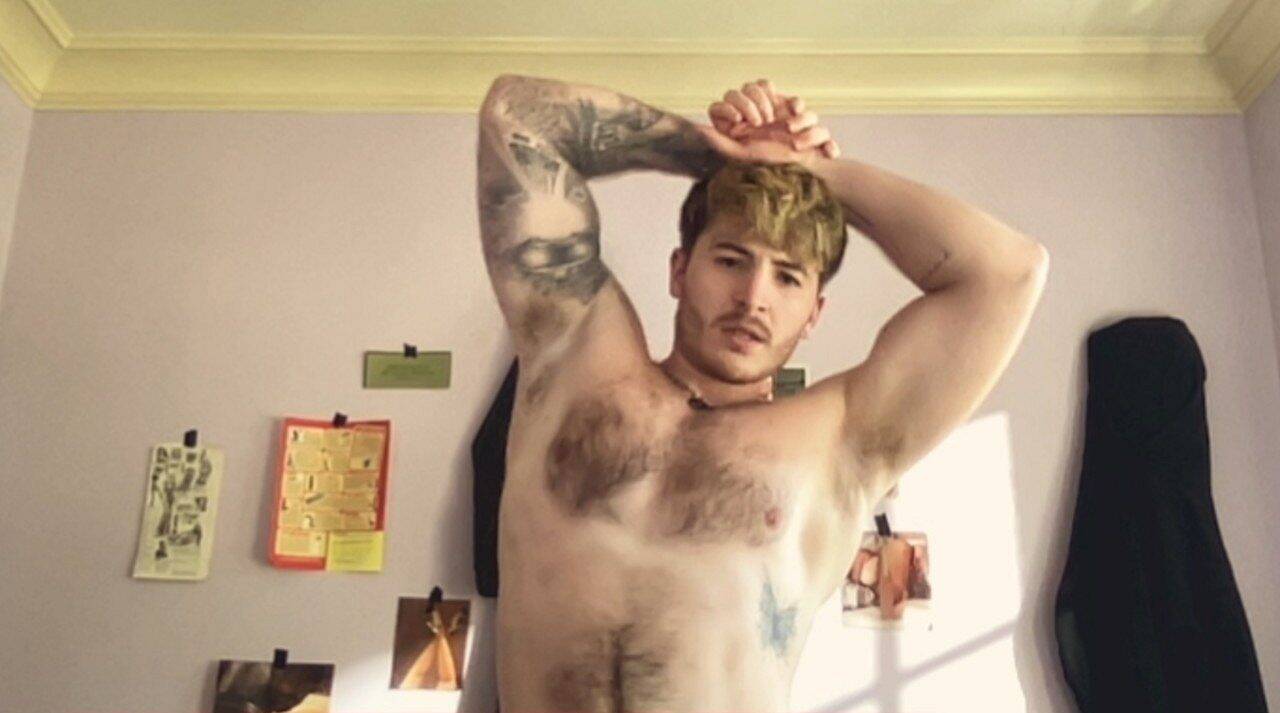
Kieron Moore plays Aaron Eagle, a homosexual cam boy who finds himself in a face-to-face session with Hank Grant (Reed Birney), a former teacher from his childhood who was sentenced to prison for sexual misconduct with one of his underage students.
The plot presents a dynamic between two characters, revealing an uncomfortable, and sometimes deeply disturbing, exploration of sexual fetishes and taboo themes, highlighting the delicate balance that the work seeks between freedom of expression and the complexity of traumas related to abuse, a constant challenge for productions that address such narratives.
Moore, recognized for his role as a homophobic recruit in the acclaimed Netflix series “Boots,” received the script for “Blue Film” through his agent. While many agents might advise against roles in LGBTQIA+ films with sensitive themes such as pedophilia, his manager believed that Kieron would be ideal for the character. “I had no idea what it was about, but the script was a real page-turner for me. I thought, ‘Wow, wow, wow, wow,'” Moore recalls. “Then I read it three times in a row. I thought, ‘This can’t be real’. I immediately fell in love with the idea of playing him.”
A video call meeting followed with Moore, Birney and the film’s writer and director, Elliot Tuttle. “We had a really good reading and Reed and I cried during one of the scenes,” recalls Kieron. “Reed sent me a beautiful message, and two weeks later I was in Los Angeles to make the film.”

Without much time to prepare, Moore sought guidance from content creator friends, who helped him clarify some doubts. “This in a way broke down barriers for me regarding my own shame, my own taboos. Our own explorations and endeavors are completely human, normal,” explains the actor. “I think I’ve learned that no fetish is too unusual. Many of the terms in the film are already familiar to me, as I’ve been lucky enough to be in queer spaces and surrounded by very sex-positive friends, so it’s never come as much of a shock to me.”
He goes on to mention a friend who saw the film and commented, “How much better the world would be if we were all a little more honest about these little parts of ourselves, the fetish or the shame or whatever, because we would all feel a little less weird and alienated.” Moore concludes that this was his main lesson.
Despite his very convincing performance, especially in the opening scene depicting his work as a cam boy, Moore claims that the experience was not natural for him. “I love being dressed up. I’m a bit of a grandfather,” he says, laughing. “So there was something quite liberating about that… and once I started, I thought, ‘If I could take even 5% of that confidence with me, it would be so empowering’. I felt really connected to my body, which was really beautiful. I hope to carry that into all future roles.”
The journalist took the opportunity to question Moore about the unexpected cancellation of “Boots” by Netflix, after just one season. Although many speculated that the decision was linked to political pressure from the Trump administration, the head of the platform, Ted Sarandos, declared in February that this hypothesis was “absolutely false”.
“It’s an answer above my level of knowledge, but I think it would be difficult to argue that it wasn’t a factor considered in the decision-making,” Moore commented. He adds: “The series was really successful, and that’s all we know.”
“Blue Film” is currently available for rent and purchase on several digital platforms.