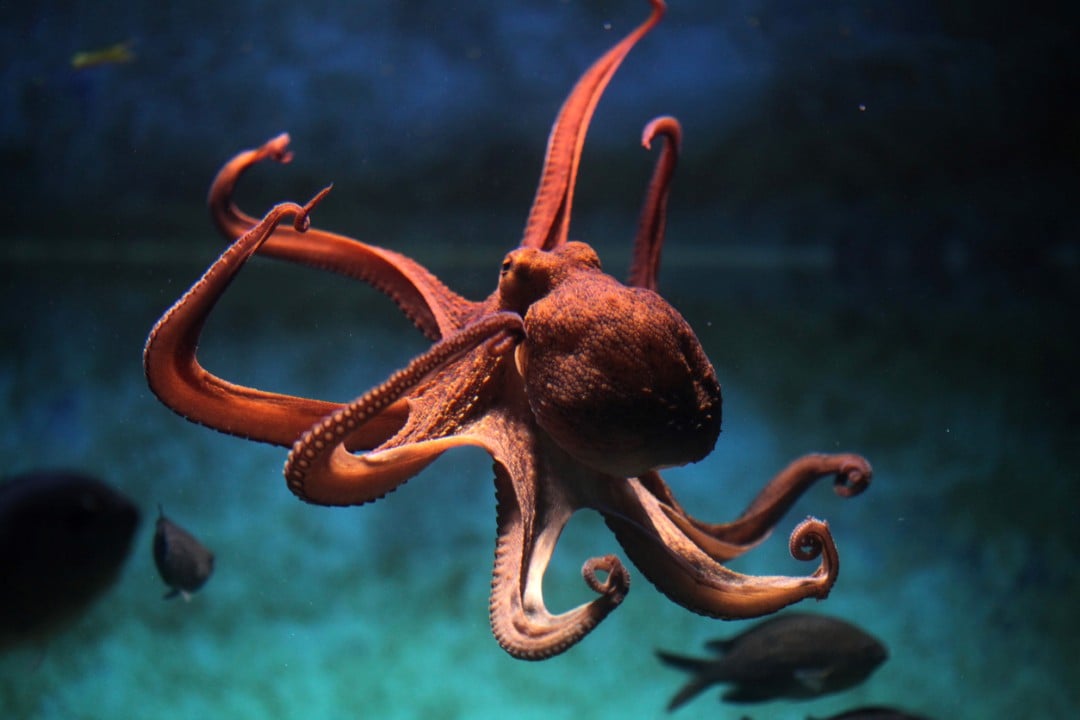
Recent research, published in the scientific journal Current Biology, revealed that octopuses are capable of using mirrors to identify the location of hidden food. This remarkable demonstration of spatial reasoning, which had not previously been observed in invertebrates, surprised the scientific community.
The mirror challenge for two-spotted octopuses
To further understand the intelligence of these mollusks, scientists at Dartmouth College conducted a fascinating experiment. The study involved three specimens of California two-spotted octopuses (Octopus bimaculoides) and its main objective was to verify whether these animals could be trained to use a mirror to locate a food source that was outside their direct field of vision.
Cognitive neuroscientist and Dartmouth professor Peter Tse commented on the ability to learn. “We are not born knowing how to use a mirror, but we learn. Octopuses can also learn to use a mirror to infer the location of things in the world,” explained Tse.
In the early stage of mirror training, octopuses initially addressed the reflection of their prey. It took between ten and twelve attempts for each animal to learn to approach the king crab, ignoring the reflected image.
Then, after familiarization with the mirrors, the litmus tests began. To eliminate any influence of smell or taste, virtual images of crabs were used instead of real prey.
Each octopus was placed inside an open box, with a mirror positioned exactly in front of it. A virtual crab was displayed behind the animal, visible only through the mirror. To get the reward, a real crab, the octopus needed to correctly identify the crab’s location and move toward it.
Even with the significant differences between the training and testing tasks – in training, the octopuses made a 90° turn near the mirror, and in the test, they needed to leave the starting area, make a 180° turn and go to the bottom of the tank or climb a wall – the animals got the location right in 73% of the attempts.
The results indicate that the octopuses understood the spatial relationship projected on the mirror, and did not just memorize visual cues associated with the reward. This understanding suggests a more complex level of cognition than mere conditioning.
Impact on understanding the evolution of intelligence
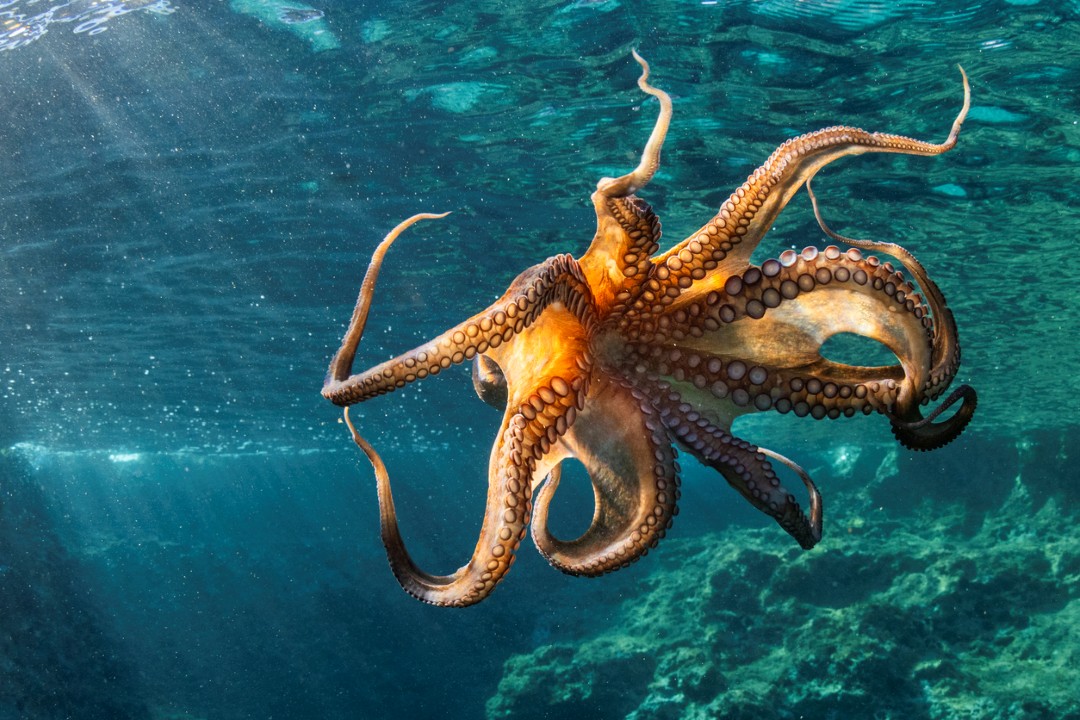
The researchers highlighted that these discoveries could transform the way the evolution of intelligence is understood. The ability of a being as evolutionarily distant as octopuses to develop a similar neural solution to a complex cognitive challenge such as using mirrors reinforces the theory of convergent evolution, where different species arrive at similar paths to solving problems.
Mary Kieseler, one of the researchers, emphasized this evolutionary distance. “Octopuses are among the animals most distant from humans in evolutionary terms, as our last common ancestor was a worm that lived between 350 and 500 million years ago,” he said.
Using mirrors to identify objects that are not directly visible is considered a form of mediated perception, and some scientists see it as a possible precursor to self-recognition. This ability is fundamental to the navigation and survival of many predators.
“Predators are very effective when they have a mental map of their territory so they know where they are in relation to the environment,” Tse added. “Our work suggests that octopuses may also have internal maps, an internal representation of space.”
More studies will be needed to determine whether octopuses’ learning occurred through simple associations or whether they actually use an internal map of space to navigate and interact with the environment.