Comet 3I/ATLAS reveals secrets of star system older than the Sun
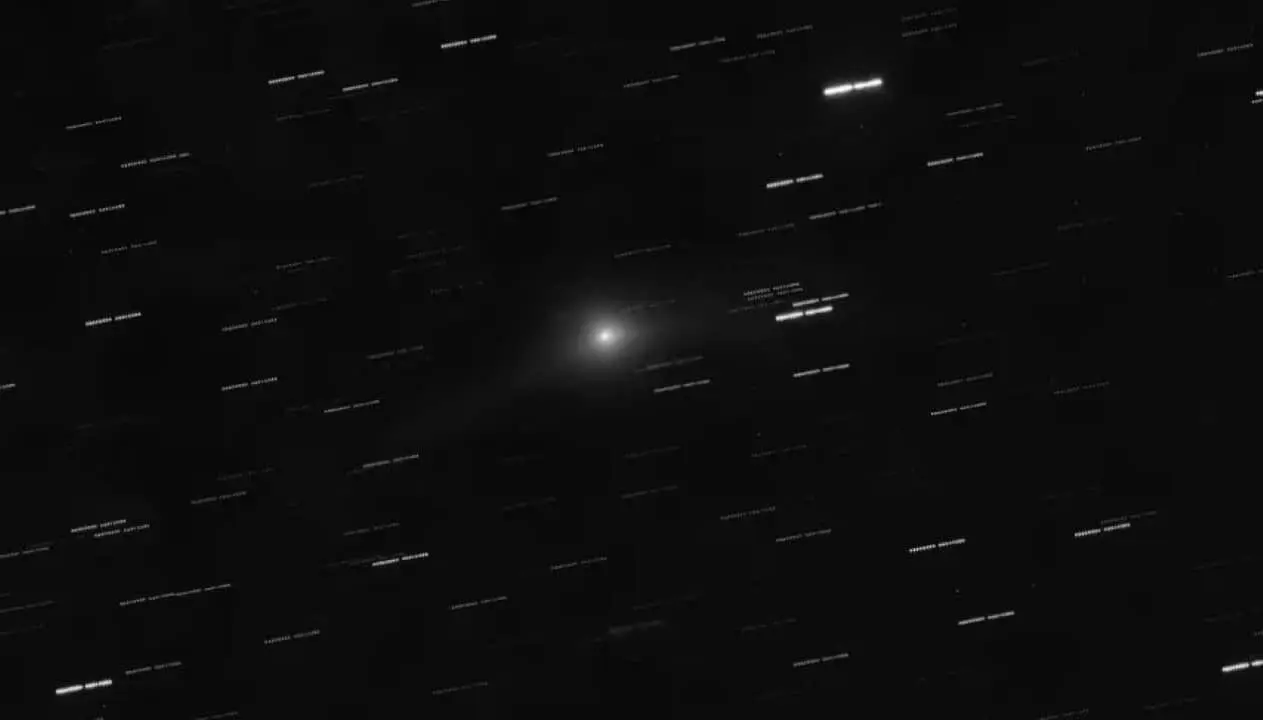
Recent research has brought new evidence about the origin of the interstellar comet 3I/ATLAS, the third object from outside the Solar System ever identified. The study, published in the journal Nature Astronomy, suggests that this celestial body could be a “cosmic fossil”, formed around a star much older than the Sun and rich in light chemical elements, characteristic of the early universe.
Led by astronomers from the University of Edinburgh, Scotland, and the University of Liège, Belgium, the investigation used the European Southern Observatory’s Very Large Telescope (VLT). For the first time, scientists were able to analyze the isotopic proportions of a comet originating in another star system, a kind of chemical “fingerprint” that reveals the conditions of its birth.
“They are like fossils from a planetary formation process that occurred very far away, but that we have the opportunity to study much closer,” said astronomer Cyrielle Opitom, the main person responsible for the study, in a statement.
On the same topic: James Webb reveals: interstellar comet 3I/ATLAS could be up to 12 billion years old and is a fossil from the early days of the Milky Way
How 3I/ATLAS became a visitor from another star system
Interstellar comets are celestial bodies composed of ice that form in the vicinity of other stars and, due to gravitational interactions, are eventually ejected from their home systems. It is extremely rare for these objects to cross the path of the Solar System.
3I/ATLAS represents the third object in this category to be discovered, following ʻOumuamua, observed in 2017, and 2I/Borisov, identified in 2019. Its particularity lies in its brightness, which was sufficient to allow an in-depth analysis of its constitution.
The researchers used the UVES instrument, coupled to the VLT, to quantify the proportions between different carbon and nitrogen isotopes found in the cyanide molecules emitted by the comet. These isotopic relationships function as a record of the physical conditions present during their formation and tend to remain practically unchanged over billions of years.
“Unlike comets in our Solar System, this interstellar visitor has exceptionally high carbon and nitrogen isotopic ratios,” explained Aravind Krishnakumar, one of the work’s co-authors.
Evidence suggests that the comet may be older than the Solar System
The findings indicate that 3I/ATLAS emerged in the most distant parts of a planetary system that revolved around a star with low metallicity, a term used to describe celestial bodies with few elements heavier than helium. This stellar profile is typical of the first generations of the Universe, when it was young and less enriched by elements forged in star explosions.
See Also

Electrical discharge knocks man off roof in Jaguaruana after contact with power lines

Global auction raises US$11.9 million and Brazil’s historic currency reaches record value

Former fighter Prichard Colón dies at age 33 after decade in a vegetative state
More on this story: Data from James Webb indicates comet 3I/ATLAS is older than the Sun and challenges galactic theories
If this assumption is correct, the comet would be older than the Solar System itself. According to the researchers, the evidence indicates an object more than twice the age of the Sun, which was formed approximately 4.6 billion years ago.
“3I/ATLAS is a truly exciting opportunity to investigate the composition of another planetary system, one that formed long before our Sun and Solar System even existed,” said Rosemary Dorsey.
The results also align with another study published in the journal Nature, which used observations from the James Webb Space Telescope. The team identified a similar proportion of carbon isotopes and high levels of deuterium, known as heavy hydrogen, strengthening the thesis that the object originated in an environment very different from that which generated the Solar System’s comets. Additionally, observations made with the Atacama Large Millimeter/submillimeter Array (ALMA) also revealed unusual amounts of deuterated water in the comet, further evidence of its primordial provenance.
Learn more: Astronomers discover that interstellar comet 3I/ATLAS is three times older than Earth
As 3I/ATLAS moves further away from the Sun, its brightness decreases and observation becomes progressively more challenging. However, scientists predict that its passage marks just the beginning of a new stage in the investigation of interstellar objects. In the future, the Extremely Large Telescope (ELT), under construction by the European Southern Observatory (ESO), should enable similar analyzes even on considerably less luminous objects.
“The field of interstellar objects is still very new and we really don’t know what to expect. Every time a new one is discovered, we have new surprises,” concluded Opitom.