Subscribers to the most popular streaming platform on the planet face difficulties accessing the catalog of films and series this week. Several reports indicate that the system presents severe slowdowns and constant crashes when playing video in multiple regions. Although the volume of complaints has skyrocketed on independent monitoring platforms, the entertainment giant maintains the position that its servers operate within the most absolute normality. The contrast between the real consumer experience and the official corporate positioning has generated a wave of frustration on social media.
The public’s daily dependence on on-demand services makes any technical fluctuation immediately noticeable. When the main application fails to deliver the promised content, customers quickly seek to confirm whether the problem is with their local connections or the provider’s infrastructure. In this specific case, data aggregated by third parties clearly indicates that the root of the obstacle lies in the company’s own processing centers, affecting the delivery of data packages to thousands of homes simultaneously.
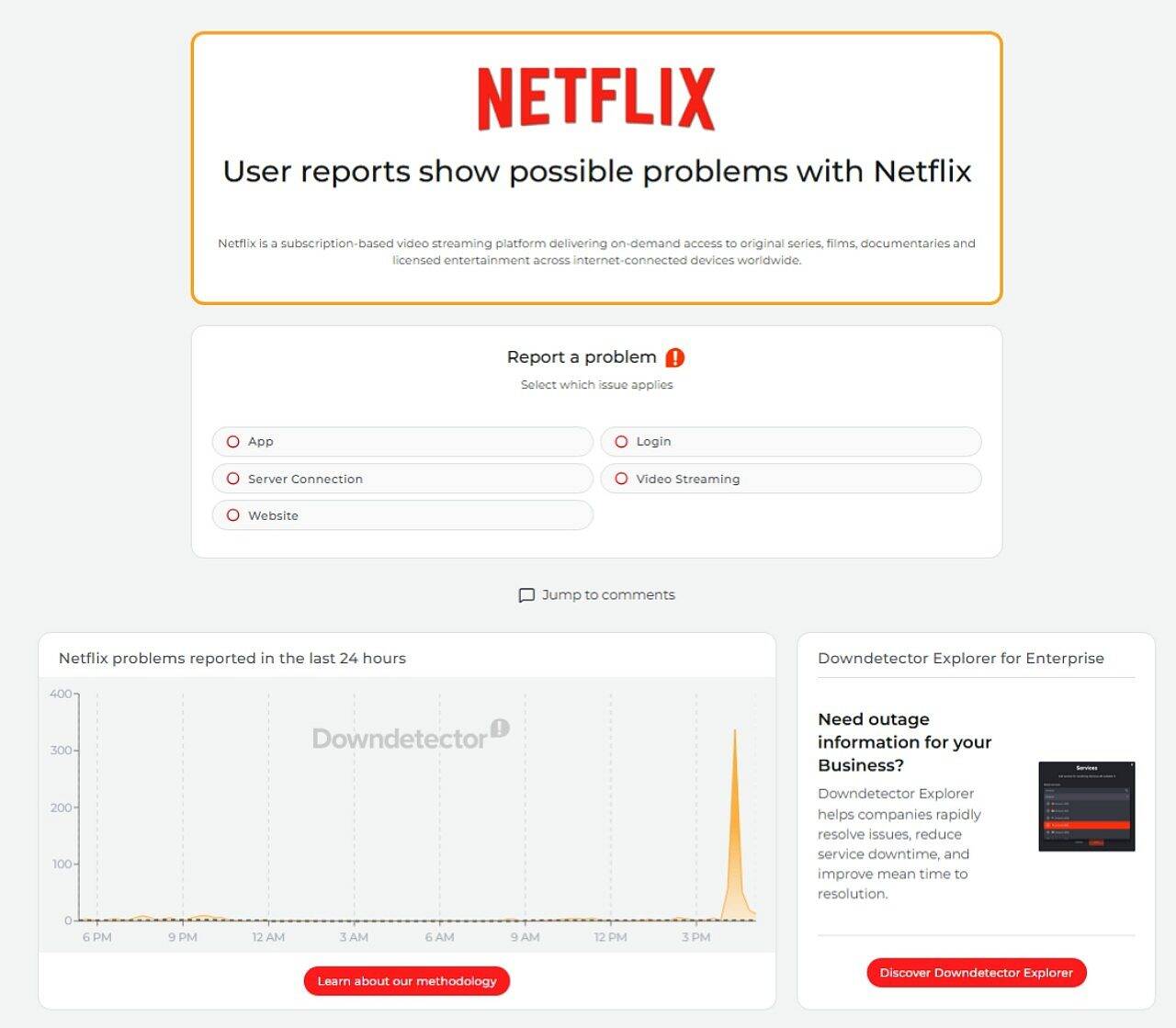
The beginning of failures and the jump in the volume of notifications
The instability records gained strength from 4:10 pm, Brasília time, which is equivalent to 7:10 pm in Coordinated Universal Time, on August 5, 2026. From that exact moment, the graphs of websites specializing in network monitoring showed a vertical spike in warnings issued by users who were unable to start their sessions. The persistence of the scenario over the following hours confirmed that it was not a simple momentary fluctuation in the internet route.
Complaint traffic was 7.3 times higher than the historical average recorded for the same day and time. Internet infrastructure experts point out that jumps of this magnitude are rarely false alarms, indicating real bottlenecks in data distribution. Such a significant increase in the volume of complaints usually points to failed internal software updates or communication problems between main databases and content distribution servers.
Main obstacles faced by subscribers while browsing
Anyone trying to enjoy their leisure time encounters technical barriers that prevent the visual interface from loading properly. Diagnostic tools captured a clear pattern in the errors reported by affected customers. The application developed for smart televisions, video game consoles and mobile devices unexpectedly freezes, forcing the software to close abruptly and requiring the device to be restarted for a new attempt.
The technical survey detailed the main anomalies that are damaging the experience of those who pay for the service monthly:
- Direct communication failures with central servers, resulting in generic error screens.
- Chronic connectivity issues that prevent user account authentication and login.
- Network irregularities that cause swapped thumbnails to load and incorrect title descriptions.
- Sudden application crashes right after profile selection, even before the catalog is displayed.
These obstacles turn the simple task of choosing a movie into an exhausting and unpredictable process. Slowness directly affects image quality, forcing the system to deliver much lower resolutions than expected, often culminating in a definitive drop in the video signal in the middle of a scene.
Regions most impacted by the drop in service performance
The mapping of the failures shows that the problem has an international reach, but affects English-speaking countries with much greater severity. The United States and the United Kingdom lead the instability ranking alone, concentrating a quarter of all calls opened on availability check platforms. Canada appears next in the survey, accounting for six percent of global notifications registered by tracking systems.
Within the United States, highly populated states such as California and Florida recorded the highest outage rates, which makes sense considering the density of users and concentration of servers in these areas. The rest of the alerts are spread across dozens of other countries, amounting to less than half of the total volume of complaints. This geographic distribution suggests that content delivery networks (CDNs) responsible for delivering video files in North America and Europe may be experiencing unanticipated traffic overload.
Independent monitoring contradicts the company’s official version
Status Tracker, a dashboard focused exclusively on the health and uptime of web applications, documented one hundred and forty-two new formal complaints within a twenty-four hour span. Of this significant amount, fifteen occurred in a space of just sixty minutes, showing that instability persists and continues to affect new accounts. The technical data collected by these portals classifies the current situation as a clear degradation in performance.
In network engineering practice, a performance degradation means that the infrastructure has not suffered a total blackout, but is operating at a severely reduced capacity. The client can even open the website or application, but data packets take much longer to travel from the server to the television screen. This type of partial failure is notoriously difficult to diagnose quickly, as the central system continues to emit signals that it is online, masking the real slowness experienced at the end of the connection.
Corporate positioning and silence about technical failures
Despite robust evidence collected by multiple independent services and thousands of reports, the platform’s administration chose to maintain a stance of denial. No clarification note has been sent to the specialized press or published on official support profiles on social media to date. The company’s official status page, which should serve as a beacon of transparency, only displays a standardized message stating that there is no interruption in the streaming service at the current time.
This profound divergence between public monitoring panels and corporate communication tends to generate unnecessary strain on the relationship of trust with consumers. When the user finds that their fiber optic connection works perfectly for other heavy tasks, but fails miserably only in the movie application, the company’s denial sounds like an attempt to minimize the problem. Subscribers can only wait patiently for the connection routes to be stabilized and corrected silently behind the scenes by the company’s engineers.