

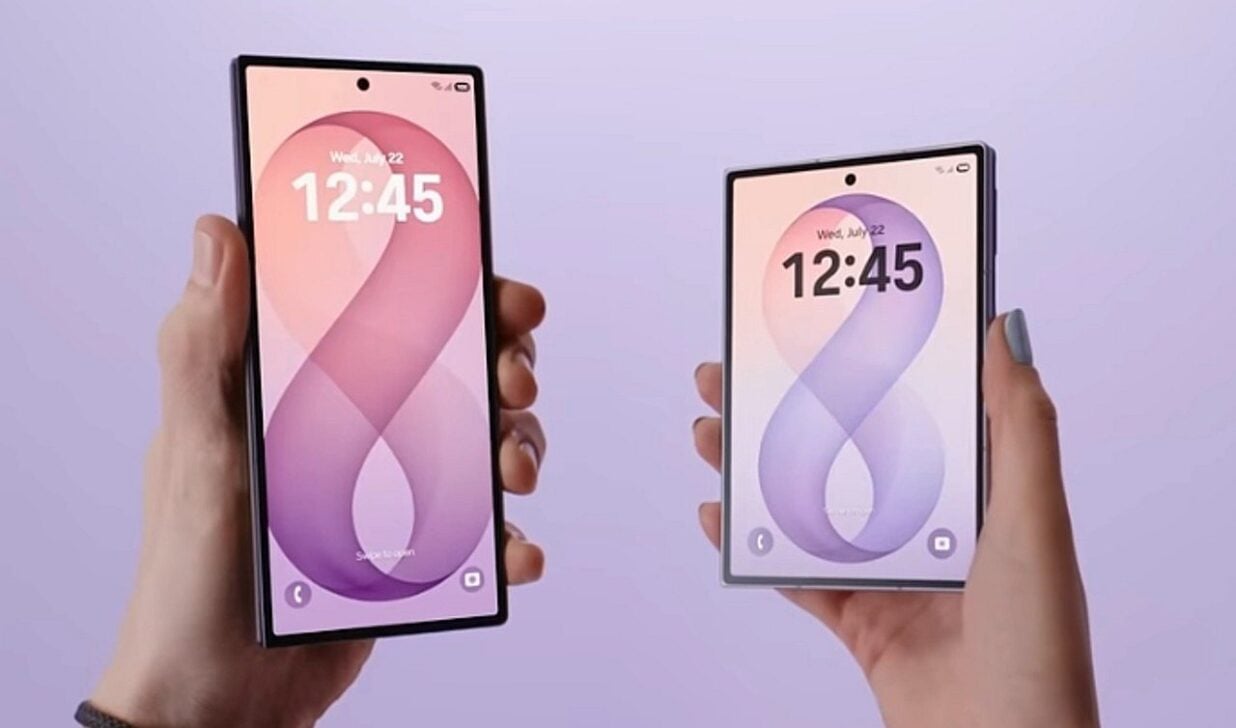
Samsung introduced its latest foldable phones to the Brazilian market on August 6, 2026, with the Galaxy Z Fold 8 standing out. This model features a reduced and wider external screen, designed for users looking for a compact device without the narrow format common to previous Fold foldables or the Flip’s very small panel.
A journalist was able to test the Galaxy Z Fold 8 after launch, highlighting the smaller, wider screen model, which has been informally called the “passport format” due to its compact dimensions.
Even for those who are enthusiasts of large-screen cell phones, such as the Galaxy S Ultra and iPhone Pro Max lines, the new Fold 8 proposal proved to be surprising, exceeding initial expectations.
The initial review of this device explores how the Galaxy Z Fold 8 represents a notable return for smartphones with smaller screens, a type of device that has practically disappeared in the most recent generations on the market.
Why Preference for Smaller Screens Has Resurfaced Among Consumers
In recent years, consumers who preferred compact cell phones have faced a shortage of options on the market. Devices like the iPhone 13 mini, Google Pixel 4a or even the Galaxy S10e (which was almost 6 inches) were popular among those looking for power in a smaller format.
On the same topic: Galaxy Z Fold 8: record 5.2 million in pre-sales creates logistical challenge
However, as of 2021, most of these models with smaller screens have been gradually eliminated from shelves. Despite attempts like Asus’s Zenfone 10, launched in 2023 with 5.92 inches, this segment of compact smartphones is almost extinct.
The Galaxy Z Fold 8 appears as a solution for this niche, with its 5.5-inch external screen. It appears lower than an iPhone 13 mini, although a little wider, providing a perfect fit in the user’s palm.
Galaxy Z Fold 8 usage experience for those who like larger screens
Those who are used to wide-screen smartphones, such as the Galaxy S22 Ultra and its almost 7-inch panel, will find it an excellent tool for various activities, except for operating the device with just one hand.
The main advantage of a cell phone with a large screen is the comfort it offers when watching videos, films and series.
The Galaxy Z Fold 8 manages to combine the best of both worlds. It allows use with one hand in situations such as public transport and, when more comfortable, it can be unfolded to display videos on a 7.6-inch screen, something that traditional cell phones do not provide.
In addition to the overall size, the usable screen area of the Fold 8 has been improved. Previous models, such as the Galaxy Z Fold 7, although they had a considerable internal display, did not use all the space to display videos efficiently.
In the previous version, multimedia content appeared centered, with significant black borders on the top and bottom sides, giving the impression of watching a video on a regular cell phone, but on a physically larger screen.
Portability and security: carrying a foldable cell phone on a daily basis
The issue of portability on public transport highlights another advantage of the Galaxy Z Fold 8: its compact format, when closed, allows it to fit more easily in your pocket.
More on this story: Early sales of Samsung foldable cell phones break records in South Korea
Despite being a foldable device, its thickness, when closed, is comparable to that of conventional smartphones. The device measures 9.7mm, while the Galaxy S25 Ultra is 8.2mm and the iPhone 17 Pro Max is 8.8mm.
This means that the device is discreet in your pocket and does not cause discomfort, even when wearing tighter-fitting clothes.
The experience of a cell phone theft on public transport, where a large device was partially exposed and was easily stolen in a crowd, serves as an example.
The excessive size of the previous smartphone caused it to protrude out of the pocket, making it easier for thieves to attack in a busy train station.
It is believed that the Z Fold 8 would offer greater security against theft. As it is more compact, it fits better at the bottom of the pocket, especially in wider pants, making it less visible and accessible.
Learn more: Promising new cell phones arrive in the second half of 2026 and focus on AI and foldables
What situations justify opening the Galaxy Z Fold 8 screen?
In the first days of use, the main incentive to open the Galaxy Z Fold 8 was the consumption of videos and series. Although the external screen already has a good proportion for this purpose, the larger internal display offers a superior format and display area.
However, viewing multimedia content is not the only scenario in which the device’s open mode is advantageous.
The split-screen functionality has proven to be particularly useful in a variety of contexts: from watching videos and having a conversation on WhatsApp simultaneously, to accessing an authentication code via email while another app remains open, or even using the voice recorder and a notes app during interviews.
Apart from these specific needs, the device proved to be fully functional in closed mode, with its external screen being suitable for most daily activities, including typing, which proved to be efficient and without major difficulties.
Learn more: What’s new in the Samsung Galaxy Z Fold 8: analysis highlights advances and challenges in its generation
In practice, the device is rarely opened unless the user requires an expanded viewing area.
Limitations of the Galaxy Z Fold 8’s “passport” format
Despite its qualities, the “passport” format of the Galaxy Z Fold 8 still cannot be considered ideal. Initial observations highlighted two issues that caused some discomfort.
The first of these is the need to adapt the display of content from platforms such as Reels and TikTok on the external screen.
Due to the almost square aspect ratio of the display, videos initially appeared cropped. However, applications like Instagram and TikTok have already implemented corrections, displaying content complete with black bands on the sides to maintain vertical orientation.
The second issue involved the Gringo app, which made it impossible to log in due to the access icon being cut off due to the unusual aspect ratio of the screen, indicating a flaw in the app’s optimization that may be corrected in future updates.
While one issue has already been fixed and another may be resolved soon, these incidents raise concerns that less popular apps or apps with slower update cycles may not receive the same attention to run flawlessly on a device with specific screen aspect ratios.
There is no guarantee that all apps will be updated, which suggests that the challenge is not with the device itself, but with adapting the Android ecosystem and its apps to innovative screen formats.