Asteroid Bennu: NASA finds life components that question hot water theory
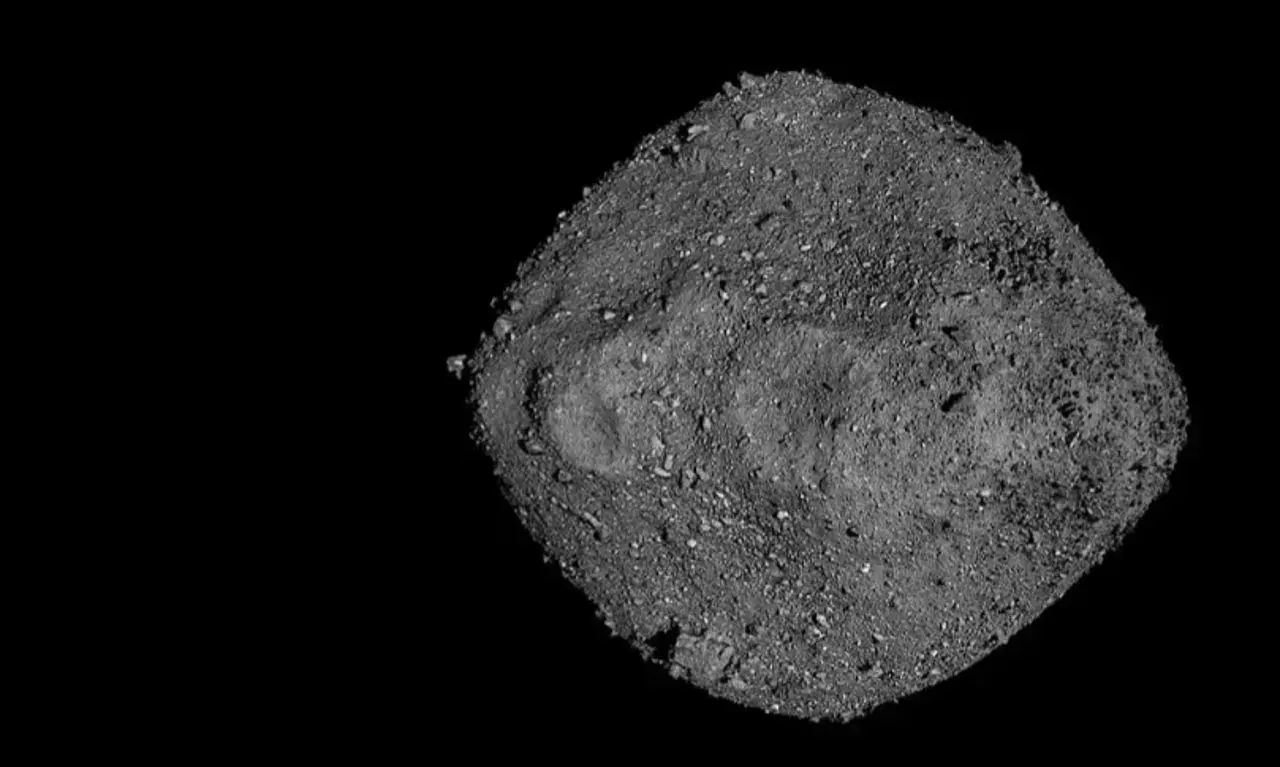
Material collected from the asteroid Bennu exposed the presence of glycine, an amino acid that formed under conditions of intense cold and high radiation. This discovery confronts the traditional view that the components of life arise only in warmer aqueous environments, indicating multiple routes for the formation of elements essential to biology, even in icy areas of the Solar System.
The search for amino acids and the surprise in Bennu
The arrival of samples from the asteroid Bennu to Earth, via NASA’s OSIRIS-REx mission, generated great anticipation. However, what the researchers discovered in the laboratories exceeded expectations: intact amino acids, preserved in a space body that traveled for millions of years in space.
Among the findings was glycine, the most basic amino acid and one of the crucial elements for the formation of proteins. This revelation strengthened the belief that the essential components for life are present throughout the Solar System, but it also generated a puzzle: how could these substances form in a place that never had liquid water?
The formation of amino acids and the warm water model
Until recently, the prevailing theory about how amino acids originate was the Strecker synthesis. This chemical mechanism requires the presence of liquid water at moderate temperatures, allowing simpler molecules to combine and create more complex structures.
The difficulty lies in the fact that the asteroid Bennu does not demonstrate conditions that would allow such a process. It originated in the coldest and most distant parts of the Solar System, without showing signs of having had bodies of water or aquatic activities for long periods.
Therefore, if the classical approach demands liquid water, the question that arises is how to justify the existence of amino acids on a predominantly cold and arid celestial body.
Learn more: Discovery in New Jersey meteorite reveals molecules crucial to the origin of life
Alternative explanation: the origin of compounds in space ice
A recent investigation, published in the Proceedings of the National Academy of Sciences (PNAS), presented a different hypothesis. The group of scientists examined the isotopic composition of glycine extracted from Bennu and compared it with that of the well-known Murchison meteorite, which impacted Australia in 1969.
The distinction was unequivocal.
Although the glycine from the Murchison meteorite exhibited traits aligned with the Strecker synthesis, the amino acid from Bennu indicated formation under conditions of extremely reduced temperature and under strong cosmic radiation.
More on this story: Bacteria created with 19 amino acids defy fundamental law of biology
See Also

The essential productivity tools for phones and tablets in 2026

Russian court sentences Conor Kennedy, husband of Giulia Be, to prison for mercenarism

Luigi Mangione’s confession in court reveals murder of CEO in New York
This evidence indicates that some amino acids may have developed directly in ice exposed to radiation, during the initial phases of the Solar System. Instead of relying on water-rich contexts, these molecules would have emerged in much more rigorous scenarios.
According to Allison Baczynski, who co-authored the research, the findings “change the understanding” about how amino acids were thought to be created on asteroids. The study suggests a wider variety of chemical pathways than previously imagined.
Other essential compounds found in the asteroid
Analysis of samples from the asteroid Bennu has brought other organic compounds to light. The researchers located ribose, nucleobases, phosphates and glucose, which are essential components for the structure of RNA.
On the same topic: Scientists propose a new way to search for extraterrestrial life with analysis of molecular organization
The presence of these molecules does not imply that Bennu once harbored life. However, they show that the “ingredients” necessary for the emergence of life can develop in different types of environments, even in places outside planets.
This finding strengthens a fascinating theory: that the fundamental components of biology may have been spread throughout the Solar System, reaching the early Earth through collisions with asteroids and comets.
The future of understanding the origin of life
The discovery does not solve the enigma of the origin of life, but it expands the alternatives considered. If amino acids can form in both water and ice contexts under radiation, this indicates that the chemical landscape of the Solar System in its early days was more complex than proposed by the conventional model.
The next step involves comparing Bennu’s samples with those from other asteroids. Initiatives such as the Japanese Hayabusa2 mission, which brought material from the asteroid Ryugu, can help determine whether this formation mechanism is commonplace or a rare occurrence.
Even in a field as established as astrobiology, new information demonstrates that there is still a long way to go to fully understand how simple chemical reactions result in intricate biological complexity.
More on this story: Scientists reprogram bacterial genome to operate with 19 amino acids in biotechnological breakthrough
If the building blocks for life can emerge in extreme cold conditions in space, the question may no longer be just “where can life emerge” but rather “how many times has life had that possibility.”