Fossil analysis in China suggests new human species with larger brain
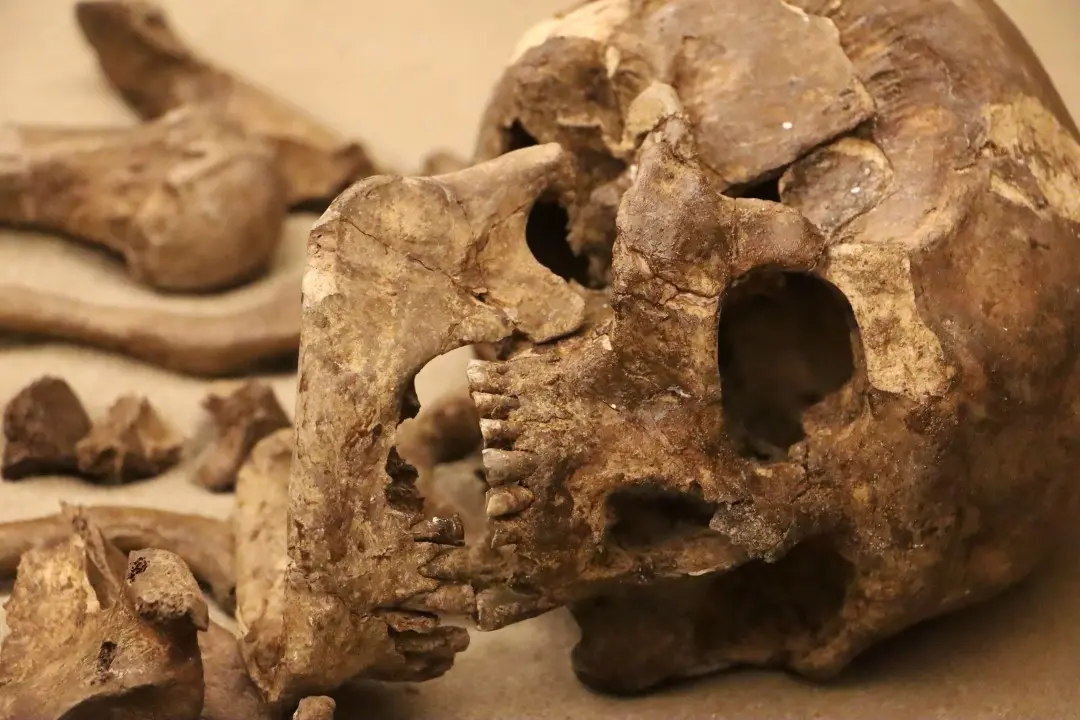
Researchers in China are studying a set of fossils that display unique human characteristics, raising questions and defying scientific categorization for many years.
These finds, which include skull fragments, teeth and jaws, were identified as remains of archaic hominids — the scientific name for ancestors of the human lineage — that inhabited the region between 300,000 and 100,000 years ago.
Christopher Bae, a professor in the anthropology department at the University of Hawaii at Manoa who has resided in Beijing for long periods of time, is one of the experts looking again at these enigmatic fossils from a new perspective.
Alongside her colleague Wu Xiujie, senior professor at the Institute of Vertebrate Paleontology and Paleoanthropology in Beijing, Bae now proposes that the time is ripe for the formalization of an as yet uncatalogued ancestral hominid, suggesting the recognition of a new scientific species.
The main characteristic of this as yet unidentified human ancestor is an exceptionally massive brain, exceeding the size of that found in our species, Homo sapiens, the only living hominid. This particularity inspired the proposed name for the species, released by Bae and Wu in a November article in the journal Nature Communications: Homo juluensis, which refers to “ju lu”, the Chinese expression for “big head”.
“The skulls of these individuals are remarkably large, with an estimated cranial capacity of between 1,700 and 1,800 cubic centimeters,” said Bae, who also detailed Homo juluensis in his book “The Paleoanthropology of Eastern Asia,” released in September. “The average minimum capacity of Homo sapiens is approximately 1,350 cc, and our overall average is about 1,450 cc. While it is not a difference in magnitude, it is significantly more robust.”
Bae and Wu’s suggestion provokes debate in the paleoanthropological community, with some experts questioning whether the set of finds really justifies classification as a new species. However, if the duo’s analysis is confirmed, these fossils could be fundamental in unraveling one of the greatest enigmas of human evolution: the origin of a mystery that began with a little finger bone in the Denisova Cave, in the Altai Mountains, in Siberia.
On the same topic: Neanderthals used stone tools to treat tooth decay 59,000 years ago
Investigation of the DNA of this small fossil revealed in 2010 the existence of a particular ancestral human population, which was named Denisovans. Currently, many people have traces of Denisovan DNA, but due to the scarcity of fossils of these extinct ancestors, scholars of human origin still do not fully understand their appearance, their habitat or the reason for their disappearance.
Forgotten fossils may reveal Denisovan history

The Chinese fragments, whose classification has proven challenging, comprise 21 fossils located in the 1970s at the Xujiayao (Houjiayao) site, located on the border between Shanxi and Hebei provinces in northern China. These specimens correspond to 16 individuals that lived between 200,000 and 160,000 years ago.
Other notable sites include Lingjing, in Xuchang County, Henan province, where skull parts were discovered between 2007 and 2014, and Harbin, in northeastern Heilongjiang province, where a skull that had remained hidden at the bottom of a well for approximately 90 years recently emerged.
Most of these fossils were previously ignored because, in their initial discoveries in the 1970s and 1980s, prevailing conceptions about the origins of humanity differed considerably from contemporary theories.
At that time, many paleoanthropologists believed that today’s human populations developed regionally from archaic hominins such as Homo erectus, which migrated from Africa about two million years ago. In fact, this scientific model, called multiregionalism, now largely refuted, proposed that there was only one species of hominin that gradually progressed to become Homo sapiens.
In this context, the Xujiayao fossils and other finds with unusual features in China were initially categorized as intermediate links between older hominins, such as Homo erectus, and more recent ones. The multi-regional model, which pointed to distinct ancestral origins for the Chinese population, resonated with nationalism and had strong support among the country’s researchers.
However, science currently has robust genetic evidence that corroborates the African origin of all Homo sapiens.
The universally accepted paradigm today is the “out of Africa” theory: the remote ancestors of modern humans living outside the African continent emigrated and dispersed globally between 50,000 and 60,000 years ago, although some pioneer populations of Homo sapiens may have left Africa approximately 200,000 years ago.
Later finds in Asia and Africa in recent decades, such as the fossils of Homo floresiensis, small hominids that inhabited the Indonesian island of Flores between 100,000 and 50,000 years ago, and Homo naledi, similar-sized hominids that lived 300,000 years ago in present-day South Africa, also indicated that the current condition, with only one species of hominid, is atypical.
“Fossil discoveries over the past five decades have clearly demonstrated that there has never been a single lineage of hominids at any time in the past, making the uniqueness of modern humans unusual,” said Carrie Mongle, assistant professor in the department of anthropology at Stony Brook University in New York, United States.
“Considering this, it is reasonable to propose that the number of species represented by Asian fossils be reevaluated; we should not automatically assume that they can all be grouped together,” added Mongle.
Cranial reconstruction and Denisovan connections
In what is described as the first “detailed” analysis of the Xujiayao specimens, Bae and Wu were able to digitally reconstruct a skull from the fragments. The research concluded that its morphology, characterized by being large, low and wide, was completely different from the skulls of other known hominid species, such as Neanderthals or Homo erectus, and was distinguished from the spherical skulls of Homo sapiens.
Next, the scientists compared these features with those of other notable fossils discovered in the same area in recent years. The skull exhibited similarities with two other unusually sized skulls found in Xuchang County, Henan Province, between 2007 and 2014, which had a capacity of 1,800 cubic centimeters.
The teeth discovered at Xujiayao showed great similarity to previous finds: they included teeth from a jaw found in the early 1980s on the Tibetan Plateau, where, in 2020, traces of Denisovan DNA were identified in cave sediments; a tooth from a cave in Laos, reported in 2022 and also linked to the Denisovans; and teeth from a jaw recovered in 2008 in Taiwan, known as the Penghu jaw.
More on this story: Historic discovery in Israel reveals complex pre-human society with 400,000-year-old artifacts
Together, Bae and Wu argue that the hominids to which these mineralized bone fragments belonged should be classified as Homo juluensis. Bae said he was aware that suggesting the inclusion of Denisovan remains “would generate arguments”, but he believes in the soundness of his team’s argument.
“I believe most people will agree with us that these fossils should be grouped together. By priority rules, once we have established this name, these finds should be assigned to juluensis,” commented Bae. “I think this is such a new proposal that people find it difficult to understand it.”
See Also

After 12 years, Hertfordshire Zoo celebrates arrival of endangered red panda twins

Court sentences Athletico defender Léo Derik to 13 years for rape

From opening jars to solving problems: the secrets of octopus intelligence
However, Mongle and other paleoanthropologists consider it premature to group the Denisovan remains with the Xujiayao fossils and classify them as a new species, Homo juluensis.
“This team’s central argument for naming a new species lies in the morphology of the braincase, but there are no known Denisovan cranial fossils that would allow a comparison with the Xujiayao cranial fragments. Without the possibility of a direct confrontation using their leading evidence, the grouping of these fossils seems rushed,” explained Ryan McCrae, a paleoanthropologist at the Smithsonian’s National Museum of Natural History who was not involved in Bae and Wu’s research.
McCrae’s second challenge focused on the lack of genetic evidence, a resource increasingly used in classifying species. Archaeologists often make major discoveries when they find a skull or other telltale bone in caves. However, Denisovans were the first archaic humans identified in the laboratory, due to advances in the study of ancient DNA, which makes them particularly mysterious.
All of the dozens of Denisovan skeletal specimens found to date are fragments, and none of them are considered unique enough to warrant a formal scientific species name like Homo sapiens or Homo neanderthalensis. Although a skull is usually, but not always, the specimen that represents a new species, as it presents several distinctive characteristics.
“Unfortunately, we still don’t know what the Denisovans looked like,” McCrae said. “They are recognized primarily by genetic data rather than fossils, so any comparison that supports the identification of more specimens must include a genetic component.”
Learn more: New research reveals that human laughter may have emerged 15 million years ago in a common ancestor
An alternative theory: Homo longi and the Denisovans
Revisiting ancient fossils is part of the scientific routine, according to Xijun Ni, professor at the Institute of Vertebrate Paleontology and Paleoanthropology in Beijing. However, despite the plausibility that the remains studied by Bae and Wu represent an as-yet-unrecognized type of ancient human, Ni opined that the co-authors did not provide enough data to officially classify Homo juluensis as a newly discovered species, a process that requires extensive analysis and is often debated.
Ni and Chris Stringer, leader of human origins research at the Natural History Museum in London, propose an alternative theory about the connection of these prehistoric pieces, based on their studies of the skull of an ancient hominid popularly known as “Dragon Man”. Discovered in scientific literature in 2021, the specimen has a fascinating history.
The skull was discovered in 1933, on the banks of the Songhua River, in Harbin, China, by an individual subjected to forced labor by the Japanese, who dominated the region. He kept the skull hidden at the bottom of a well for more than eight decades, revealing its presence shortly before passing away.
Stringer said his study with Ni indicated that most of the fossils Bae categorized as H. juluensis show greater morphological compatibility with the Harbin skull. According to Stringer, this suggests that the Xujiayao specimens and Denisovan remains could belong to Dragon Man, who received the formal scientific name Homo longi.
“Thus, the Harbin skull, which is well preserved, would represent an early Denisovan. Ongoing studies by other teams converge on the same conclusion,” said Stringer, reporting that new research on Dragon Man will be released this year.
Mongle of Stony Brook University said that while she agrees with the possibility that multiple species of ancient humans coexisted in Asia, she also believes that the fossils identified by Bae as belonging to the “loggerheads” are similar to the skull of Homo longi.
“In theory, I support the existence of several hominid lineages in the Asian Pleistocene, but I am not completely convinced of the distinction between these fossils and the recently named Homo longi,” she said.
Criteria and controversies in naming new species
Bae indicated that his analysis suggested that the Dragon Man skull demonstrates greater compatibility with fossils found at Chinese sites in Dali, Shaanxi province, and Jinniushan, Liaoning province, in 1978 and 1984, respectively, to make up Homo longi.
Deciding on the name of a new species, such as Homo juluensis, is the researchers’ prerogative, Ni noted, but they need to adhere to naming guidelines established by the International Commission on Zoological Nomenclature.
However, there is no formal approval process, and whether or not the species name remains will depend on consensus and use by other researchers in the scientific literature.
Ni highlighted that the Denisovans constitute a known population of ancestral hominids and, for this reason, the term or one of its variations should not automatically be used for others, such as the Xujiayao hominids, even if they are the same species. He compared the situation to calling all Europeans Anglo-Saxons.
“Several Western paleoanthropologists have expressed a desire to label Chinese fossils as Denisovans,” he declared. “To us, Denisovans are not, in fact, a species.”
The first person or team to present enough evidence to designate the Denisovans as a unique species technically has the prerogative to name them whatever they wish, McCrae explained.
“The Denisovans intentionally do not have a formal taxonomic name due to the scarcity of comparative material with which to name a new species,” McCrae elucidated. “This, on the one hand, benefits the field by allowing time to find more fossil evidence of the Denisovans before formalizing a species, but on the other, it allows these crucial fossils to be ‘available’ for premature assignment of a taxonomic name.”
Some paleoanthropologists hope that when the Denisovans are given a formal species name, “it will reflect the place of origin of Denisova Cave and the now widespread colloquial name “Denisovans,” McCrae said, while acknowledging that “there is no guarantee that this will occur.”
The historical period is full of fossil hominids that, morphologically, are “somewhat ambiguous,” he added. Some appear unique, but others exhibit Neanderthal traits, while still others have Homo sapiens traits, and many exhibit a combination of both, McCrae explained.
“Prematurely classifying fossils into species can distort the true understanding of ongoing events in the world, and, from a logistical perspective, it is very complicated to reverse a decision after species names have been released, regardless of adequate support,” he concluded.