Starship upper stage caught by Mechazilla after 22 hours and 32 minutes

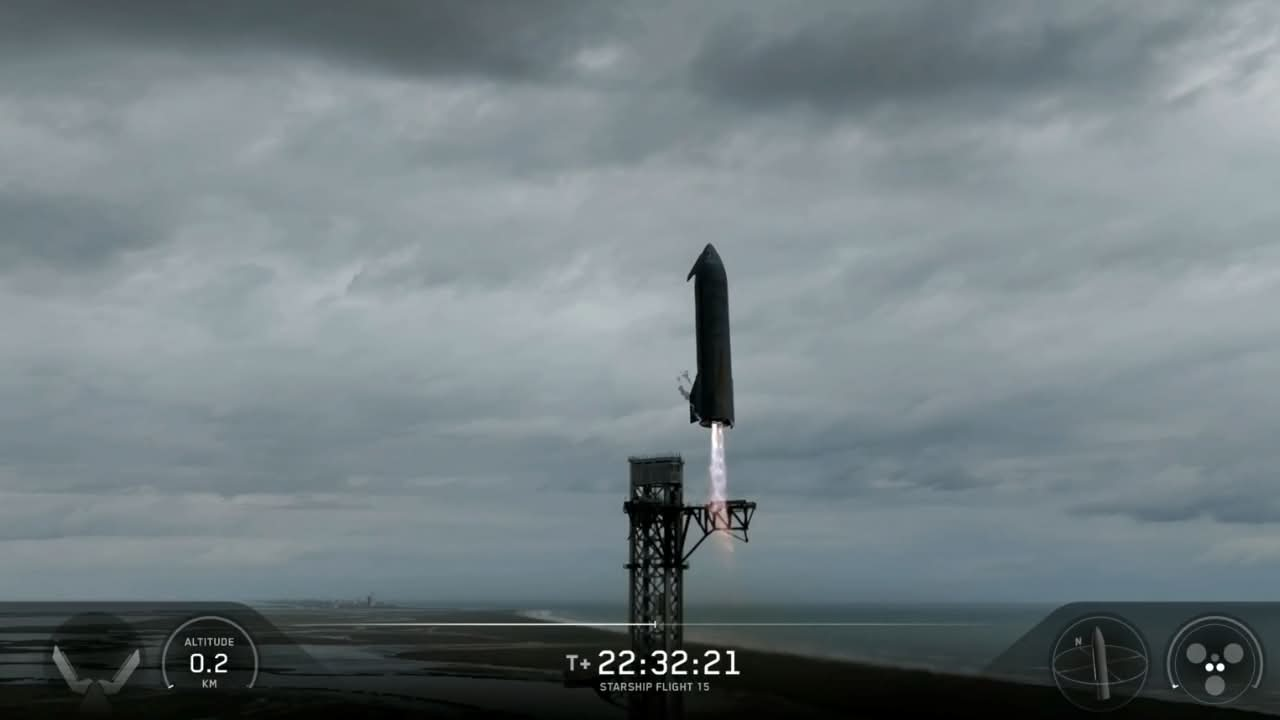
SpaceX caught the upper stage of its Starship rocket with the giant mechanical arms of the Mechazilla tower on November 14, 2026. The capture took place at the company’s Starbase facility in Boca Chica, Texas, United States, and closed Flight 15 of the vehicle. It was the first time an upper stage returned from orbit and was caught by a launch tower.
The company celebrated the milestone on its official social media accounts. In a post, SpaceX wrote: “Mechazilla catches Starship! Congratulations to the entire SpaceX team on this incredible achievement!” The result shows that the upper stage can be recovered intact after returning from orbit around the Earth.

Starship flew more than 22 hours and released 26 Starlink satellites
The mission began on Friday with liftoff from the Texas base, and the rocket reached space to start its cruise phase. During orbit, the Ship 42 vehicle released 26 Starlink V3 communication satellites, which was the main goal of its payload.
Unlike earlier missions, Flight 15 included three mandatory checkpoints over the Pacific, Hawaii and Chile to confirm that the systems were stable. After the ground team gave the green light, the ship fired its engines for deorbit and started reentry into the atmosphere.
To withstand air friction and the plasma created during flight, SpaceX updated the heat shield with new curved ceramic plates. The plates reduced overheating in the critical gaps, and the material worked as planned, so the main structure reached the skies over Texas intact.
Mechazilla arms hold the ship in midair without landing legs
After breaking the sound barrier and braking hard in a controlled fall guided by fins, Starship relit its Raptor engines a few dozen meters above the ground. The vehicle performed a vertical rotation, cancelled its falling speed and hovered while it descended slowly in line with the tower.
The articulated arms of the tower, more than 140 meters tall, immobilized the body in the air. According to the company’s design, this removes the need for a conventional landing gear, which saves room for the payload and lets the vehicle return to operations faster.
Learn more: SpaceX CRS-35 mission lifts off from Cape Canaveral with station cargo
Super Heavy booster lost in the Gulf as cause remains under review
Despite the success of the upper stage, the first stage of the same mission suffered a technical setback. The Super Heavy booster, which provides the initial thrust and separates minutes after liftoff, did not complete its return on Friday, November 13.
When the flight computer detected an anomaly in the trajectory parameters in real time, it blocked the approach of the metal arms to protect the tower. Under the safety protocol, the rocket changed course and fell into the Gulf of Mexico while engineers examine the sensor records. SpaceX has given different explanations: Dan Huot, a company spokesman, first pointed to a guidance problem and later said the system worked as designed, while Kate Tice, a company commentator, cited a low fuel mass alarm. The company has not confirmed the root cause.
Why the ship catch matters for reusable rockets and Artemis
The capture of the upper stage supports the reuse concept defended by Elon Musk, the CEO of SpaceX. The approach is key to lowering the cost of frequent launches, which the US space agency NASA needs for its Artemis program, aimed at crewed bases on the Moon, and for future missions to Mars.
The main figures of the flight are listed below.
- Launch: November 13, 2026, 7:47 p.m. Brasília time
- Launch site: Starbase complex, Boca Chica, Texas, United States
- Vehicles tested: Ship 42 upper stage and Super Heavy booster
- Payload: 26 Starlink V3 satellites deployed into orbit
- Flight duration: 22 hours and 32 minutes
- Booster outcome: return aborted and splashdown in the Gulf of Mexico on November 13, 2026
- Ship outcome: first tower catch confirmed on November 14, 2026, at 6:20 p.m. Brasília time