Helicopter collision in Rio de Janeiro: experts detail responsibilities after tragedy
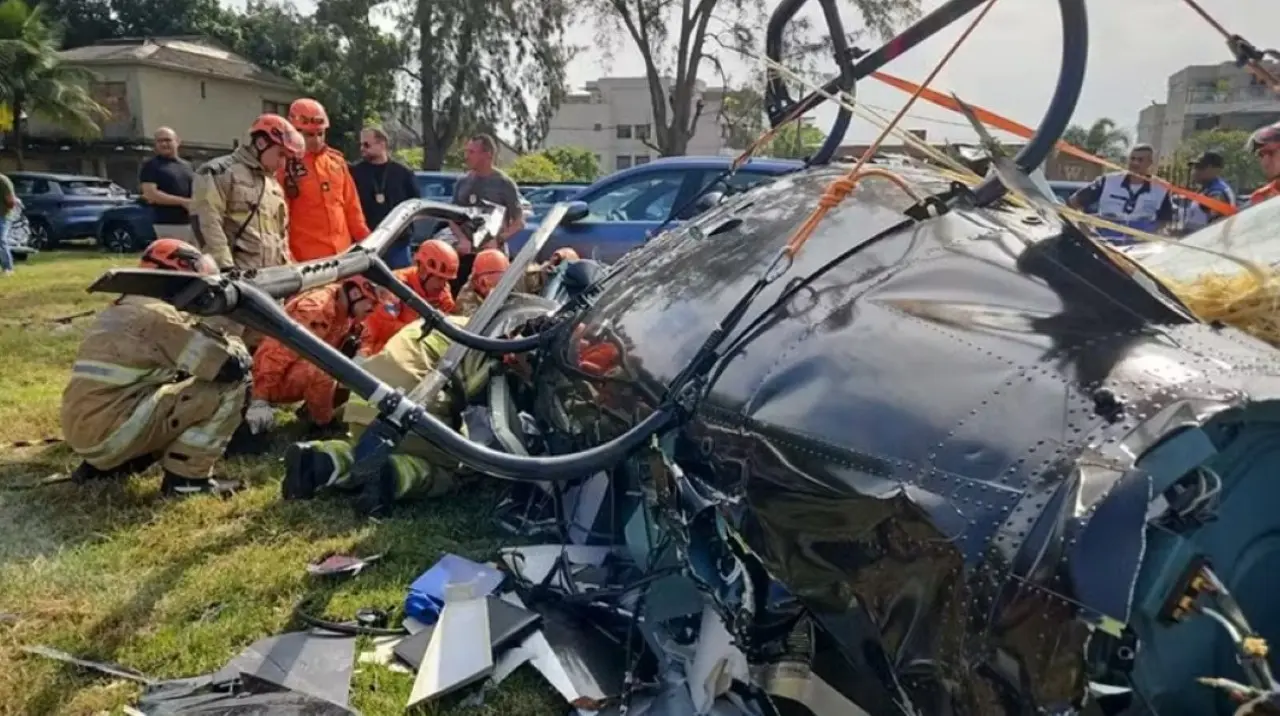
A collision involving two helicopters resulted in the death of six people on the morning of last Sunday, the 14th, in the western region of Rio de Janeiro, and raised an urgent legal question: how is responsibility defined in aerial collision situations?
As explained by Carlos Barbosa, a lawyer with extensive experience in Aeronautical Law at the firm Cerdeira, Rocha, Vendite, Barbosa, Borgo and Etchalus, the resolution of this issue is intrinsically linked to the investigation of the origins of the incident, always within the parameters established by sector legislation.
Barbosa highlighted the importance of distinguishing the different objectives of investigations following an air disaster. The technical investigation, led by the Aeronautical Accident Investigation and Prevention Center (Cenipa), focuses on determining the elements that culminated in the occurrence in order to increase operational safety in the future, without a punitive nature. At the same time, police bodies and the Public Prosecutor’s Office are responsible for investigating potential responsibilities in the civil and criminal spheres of the individuals involved, highlighting the complexity and multiplicity of fronts that a case like this requires.
In-depth analysis of the causes of the mid-air collision
According to Barbosa’s analysis, the investigation process needs to consider that accidents involving aircraft are rarely the result of a single isolated factor.
The expert points out the need for a thorough examination of the interaction of human elements, material failures and operational aspects that, together, may have culminated in the aircraft crash.
“An air accident does not arise from a single isolated point, but rather from an interconnected series of events. The investigative approach must therefore be systemic,” he said.
In addition to the human elements, which include medical and psychological conditions and the decision-making process during the flight, the investigation can cover maintenance services, the functionality of on-board electronic equipment and communication systems, the safety culture of the operating companies, pressures related to productivity, crew fatigue levels, work schedules, the exact meteorological conditions at the time of the collision, the accuracy of the data provided by air traffic control, the previously defined routes and the altitudes used.
One of the relevant particularities to be investigated in the context of the incident in Rio de Janeiro is the indication that the aircraft were operating under Visual Flight Rules (VFR). If this condition is confirmed, the main responsibility for maintaining a safe distance between the helicopters would lie with the pilots themselves, detailed Barbosa.
“The airspace environment can play a crucial role in the investigation. Aircraft in visual flights (VFR) follow the fundamental precept of ‘see and avoid’. In this scenario, the primary responsibility for maintaining separation between aircraft and preventing collisions lies with the commanders. However, the lack of specific air traffic control for helicopters in Rio de Janeiro, similar to HELICONTROL in São Paulo, does not imply automatic culpability of the State through the Department of Airspace Control (DECEA)”, explained the lawyer.
He added that the investigation will need to confirm whether visual flight guidelines were followed and whether onboard teams communicated appropriately throughout the route.
Understanding the legal bases of liability in air disasters
If the guilt of one or more participants is established, Barbosa details that civil liability in the aviation sector is initially determined by the Brazilian Aeronautics Code (CBA), established by Law 7,565/86.
In the scenario of air collisions, the determining factor for attributing responsibility lies in the thorough determination of fault.
When addressing the regulations pertaining to collisions between aircraft, the specialist detailed the way in which Brazilian legislation divides responsibility for the damage caused.
Leia Também

Messi reaches 19 goals in FIFA World Cups with great free kick for Argentina in clash with Jordan

Cristiano Ronaldo shines beyond the pitch at the 2026 World Cup with business empire and family luxury

At 41, Cristiano Ronaldo reaffirms his historic legacy and prepares to shine in the 2026 World Cup
“The Brazilian Aeronautics Code, in its article 274, determines that responsibility for damage to aircraft and passengers and property present on board will be attributed to the operator of the aircraft that caused the collision due to lack of expertise, carelessness, omission or intention. If it is demonstrated that there was shared fault, the obligation of each operator will be calculated according to the seriousness of their specific fault. If it is not possible to define this proportion precisely, the compensation will be equally divided between the parties”, he explained.
With regard to third parties who are hit by aircraft fragments, the operators’ liability is objective and joint in nature, which means that it is established without the need to prove individual fault.
Procedures and insurance for compensating victims
In addition to identifying those directly responsible for the collision, the relevant legislation also clearly defines who is responsible for paying for damages resulting from the accident.
“The main actor in determining civil liability is the aircraft operator, a figure that does not always coincide with the owner. It is the operator who assumes obligations towards passengers, crew and any third parties on the ground”, he stated.
In order to ensure the effectiveness of this repair, the legislation imposes the mandatory contracting of RETA Insurance, which covers the Civil Liability of the Operator or Air Carrier.
“If the values established by RETA Insurance are insufficient to cover the compensation for moral and material damages defined by court, the assets of the explorer himself — and, depending on the corporate structure, of the operating company — may be called upon to pay the remaining amount”, explained the lawyer.
Legal developments: administrative sanctions and criminal actions
In addition to compensation obligations, the incident may have administrative and criminal consequences. At the administrative level, the National Civil Aviation Agency (Anac) has the prerogative to initiate punitive processes if it finds non-compliance with the Brazilian Aeronautics Code (CBA), the Brazilian Civil Aviation Regulations (RBACs) or other sector-specific regulations.
“The penalties range from the imposition of high fines to the revocation of licenses, certificates and qualifications for both companies and professionals who participated”, he highlighted.
In turn, in the criminal context, the attribution of responsibility will be conditioned on proving behaviors such as lack of care, thoughtless action, technical inability or deliberate intention.
“Criminal classifications can range from homicide and bodily injury, both in the form of culpable offence, to the private crime of attacking the safety of air transport, as provided for in article 261 of the Penal Code”, he concluded.