Primordial fragments ejected by the Sun may return after billions of years in space By Maria
4 min read
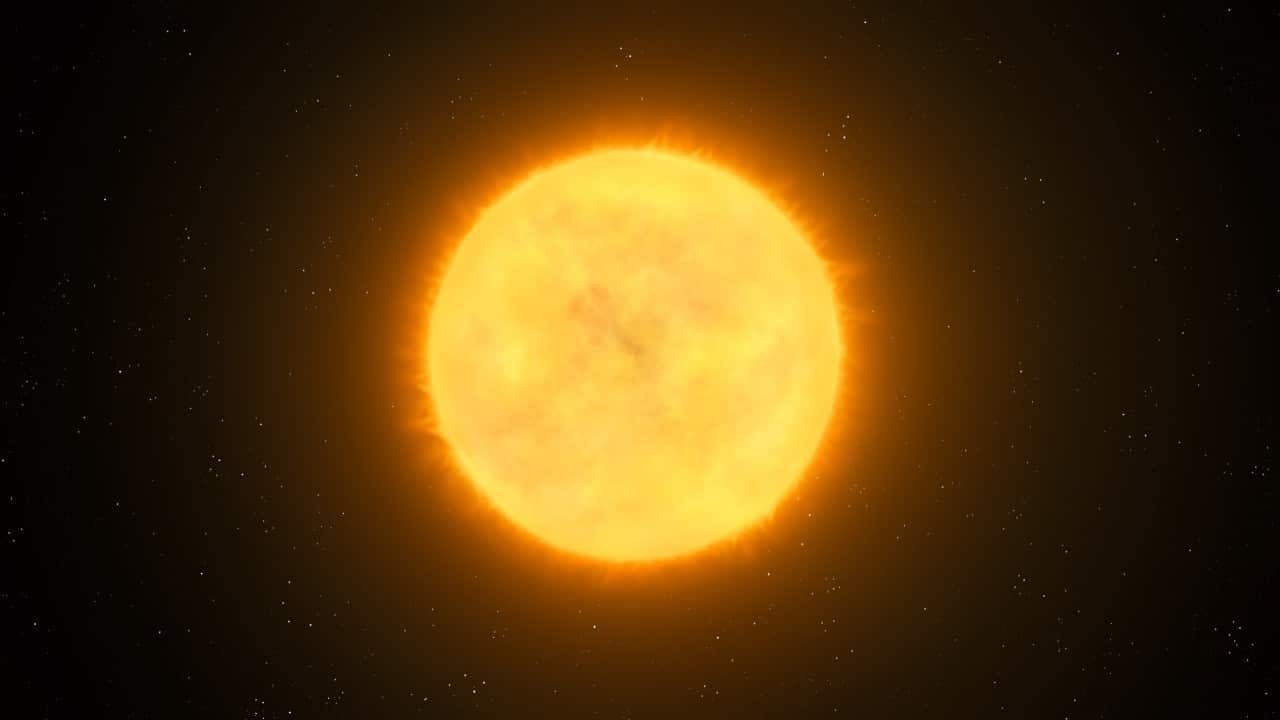 |
In the initial millions of years of its formation, the Sun propelled a vast amount of matter into space, estimated at nearly 10 quadrillion comets and primitive asteroids, as revealed on Wednesday, July 15, 2026, in a new study pre-published in the arXiv scientific archive. Although most of these celestial bodies have not made their way back, scientists are considering a surprising hypothesis: some of them could be returning to the solar system after a billion-year journey through the Milky Way.
This occurrence gains particular importance in a period in which astronomy turns its attention to objects coming from outside our system, such as 1I/’Oumuamua, 2I/Borisov and, more recently, 3I/ATLAS. These cosmic travelers, originating from other stars, provide valuable clues about the formation of planetary systems in distant galaxies. Current research, however, reverses the logic, suggesting that if other stellar systems send us fragments, the Sun may be reincorporating some of the matter it released in its early days.
Scholars have named these potential return travelers as “quasi-interstellar objects.” Unlike genuine interstellar comets, which originated near other stars and never had a gravitational bond with the Sun, these new bodies would have been born in our own planetary system, ventured into the space between the stars, and, after billions of years, returned to the solar gravitational orbit.
According to the mathematical models used in the survey, around 95% of comets and asteroids created at the edges of the solar system were expelled in their first evolutionary moments. This phenomenon dispersed approximately 10 quadrillion bodies, each larger than a skyscraper, across different regions of the Milky Way. Even with this large-scale distribution, the Sun’s gravitational force maintains an influence, albeit subtle, on a portion of the material thrown into the cosmos.

Difficulties and challenges in detecting cosmic objects
Identifying one of these objects, however, presents an immense challenge. Scientists’ calculations indicate that, annually, less than one quasi-interstellar object enters Jupiter’s orbit. This considerably reduces the chances of detection, even with the most advanced equipment. The Vera C. Rubin Observatory’s Legacy Survey of Space and Time (LSST), for example, will have the extra task of differentiating these bodies from the vast number of comets originating from the Oort Cloud.
This distant area represents a hypothetical zone located at the edge of the solar system, approximately 100,000 astronomical units from the Sun — a distance equivalent to 100,000 times the distance between Earth and our star. The Oort Cloud is seen as the birthplace of most long-period comets, which can take millions of years to complete a complete revolution around the Sun. Its theoretical condition is precisely due to the immense distance and scarcity of bodies, making individual observation difficult, even with today’s most powerful telescopes.
The secret to differentiating a quasi-interstellar object from a regular comet, or an authentic visitor from another system, lies in its speed upon entry. Purely interstellar objects, such as 3I/ATLAS — observed in 2025 and now on its final journey out of the solar system after approaching the Sun — have hyperbolic paths and high speeds, showing that they were expelled from another star long before the formation of our system. In contrast, quasi-interstellar objects move at a notably slower speed, as they are bodies that make a round-trip journey within the solar gravitational pull.
This disparity in speed would not only make them easier to identify, but also make them an unparalleled source of data. While interstellar objects carry with them a chemical “fingerprint” of other planetary systems, quasi-interstellar bodies, in turn, would be guardians of a direct record of the formation and original composition of our own solar system in its initial millions of years. By studying these returning travelers, we can decipher the distant past of our own cosmic neighborhood in a way that objects from other stars cannot offer.
New perspectives on the early history of our solar system
If astronomers are successful in identifying and confirming one of these bodies in the future, this discovery will pave the way for the reconstruction of part of the primordial history of the solar system, in particular the conditions prevailing during the genesis of the Sun and the planets. This is a period still full of mysteries to be unraveled, even with recent progress in the analysis of ancient comets and asteroids, as demonstrated by space missions such as Stardust and Deep Impact, which have already revealed the chemical complexity of these icy bodies.
At the moment, the existence of quasi-interstellar objects is a hypothesis based on mathematical models, without confirmation by direct observations. However, if proven, this discovery will join a growing series of findings about cosmic visitors in recent times, presenting a new vision: the chance that the solar system itself is, in fact, rediscovering pieces of its remote past.