Astronomers catch black hole ejecting half of the matter from neighboring star
Researchers used the powerful instruments of the Very Large Telescope (VLT), a cutting-edge optical complex operated by the European Southern Observatory (ESO) in the Chilean desert, to monitor an intense flow of energy coming from the far reaches of the galaxy. The main target of the investigation was the Swift J1727.8−1613 system, located at a distance of approximately 8,800 light-years from our planet, which caught the attention of the scientific community after a colossal explosion recorded in the year 2023. The data collected by terrestrial lenses show that these gravitational anomalies work in a chaotic manner when absorbing matter, wasting a large part of the stellar feast. The detailed observation breaks paradigms about the food efficiency of these gigantic celestial bodies.
How X-ray emission reveals wasted stellar matter
During continuous monitoring, the celestial body suddenly transformed into one of the brightest points in the sky in the X-ray range, allowing detailed tracking of its activities over months. Experts noticed that, as extreme gravity pulled the boiling plasma from a partner star, a colossal amount of this gas ended up being thrown back into the vacuum through extremely strong winds and beams of radiation. This erratic behavior contradicts the popular myth that these regions of space function as perfect cosmic vacuum cleaners, proving that the absorption mechanism faces severe physical bottlenecks. The matter that should disappear forever ends up being violently recycled by the environment itself.
On the same topic: Unprecedented observation reveals how black hole expels half of the matter devoured into space
Accretion disk mechanics and the friction that illuminates the universe
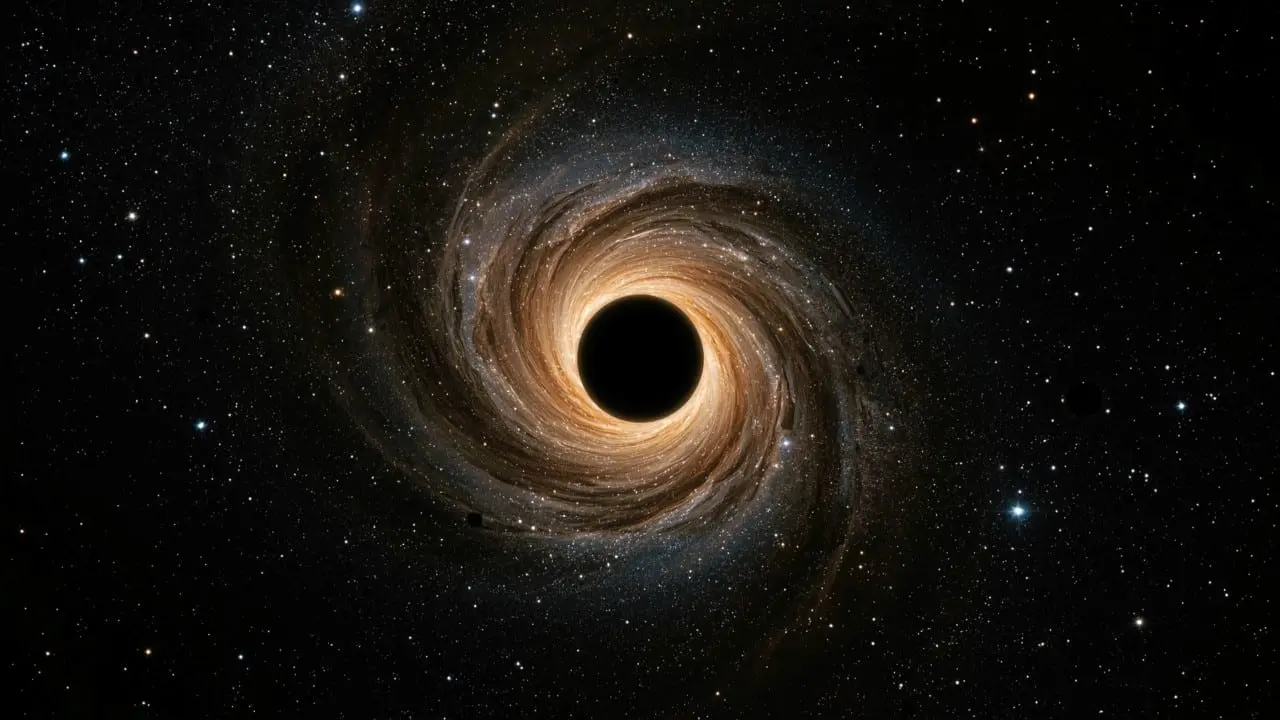
The architecture of Swift J1727.8−1613 features a dark, dense core surrounded by a swirling ring formed by the remains of the neighboring star, which is slowly being torn apart by tidal forces. Because of the laws of physics linked to the conservation of angular momentum, this gas does not fall in a straight line towards the event horizon, but gradually spirals, forming what astrophysics calls an accretion disk. The constant friction between the particles and the pressure generated by crushing gravity raise the temperature of this ring to millions of degrees Celsius, generating the intense glow captured by telescopes. It is exactly in this gravitational waiting room that most of the system’s energetic dynamics take place.
The survey conducted by scientist Noel Castro Segura, a researcher linked to the University of Warwick, in the United Kingdom, brought an important methodological difference in relation to previous analyzes on the topic. The international team managed to record the continuous transformation of the environment around the supermassive body, creating a kind of high-fidelity chronological record of the explosion. The mapping showed that the physical structure of the gas ring changes drastically at the exact moment the radiation beams are fired out of the system. This synchrony proves that the feeding and expulsion of mass are intimately connected by invisible magnetic fields.
Supersonic winds and the expulsion of gas at extreme speeds
One of the most intriguing findings of the research points out that the largest plasma expulsion peaks occurred precisely when the central absorption rate was declining, surprising theorists in the field. This temporal asymmetry indicates that the process of swallowing celestial bodies involves highly sophisticated rejection mechanics, where the energy accumulated in the disk needs to be released to avoid structural collapse. Continuous monitoring has allowed astronomers to understand the direct link between gas approaching the final edge and that escaping traveling at significant fractions of the speed of light.
More on this story: European telescope records Betelgeuse’s companion star and solves mystery
See Also

Electrical discharge knocks man off roof in Jaguaruana after contact with power lines

Global auction raises US$11.9 million and Brazil’s historic currency reaches record value

Former fighter Prichard Colón dies at age 33 after decade in a vegetative state
To understand the complexity of this mass rejection phenomenon, scientists mapped the fundamental stages of cosmic waste:
- The initial gravitational pull strips away the outer layers of the companion star, forming a whirlpool of superheated plasma that orbits the core.
- The extreme friction in the gas ring generates severe magnetic instabilities that act as a barrier, preventing the direct and immediate fall of matter.
- Polar jets shoot charged particles in directions opposite to the plane of the disk, relieving thermal and magnetic pressure from the binary system.
- Dense, continuous winds continue to blow away from the core even after the peak of the X-ray burst has disappeared from radar.
The relentless force of these stellar winds remained active long after the main banquet phase had ended, altering the chemical composition of the surrounding space. The British team’s detailed calculations suggest that the amount of mass thrown out by the jets is practically equivalent to the volume that the nucleus managed to successfully swallow during the outbreak. In practice, this means that half of all the structure stolen from the partner star ended up being returned to the interstellar medium, without ever crossing the boundary where light cannot escape. This mass balance rewrites the energy accounting of galactic explosions.
Direct impact on the evolution models of binary systems
This unexpected level of inefficiency in matter absorption forces the astrophysics community to recalculate the way systems composed of two celestial bodies age and transform over the millennia. If a gravitational anomaly systematically returns half of what it tries to consume, the lifetime of the partner star and the mass transfer dynamics of the ensemble change completely. Much of the stripped hydrogen and helium remains wandering around the galaxy, which invalidates old mathematical simulations that assumed almost total consumption by the densest object. The ejected material can even serve as raw material for the formation of new stars in the future.
Learn more: Unpublished telescope images show Betelgeuse as a double star, solving ancient mystery
Following every phase of this violent interaction, from the first detectable flash to the turbulent dissipation of gas clouds, delivers an incredibly faithful portrait of the forces shaping our galaxy. Researcher Kyle Solomons, working at the University of Cape Town and co-author of the study, pointed out that the conclusion of these explosive events carries as much crucial data as the moment of initial ignition. The final turbulence of the system reveals deep secrets about energy conservation and the mechanics of space fluids that will still guide many future studies in the area of observational astronomy.