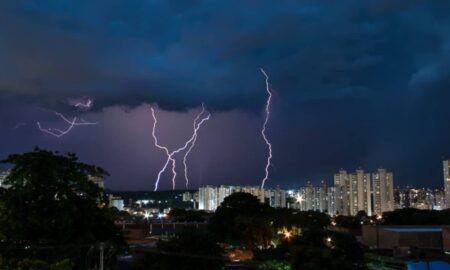
Lightning strikes football field in Thailand and kills 24-year-old player during match By Luís Henrique Costa
4 min read
 |
A fatality abruptly interrupted a sporting event in Thai territory on the afternoon of August 4, 2026. During a friendly match on the lawn of the Santiphap Stadium, a sports venue located in the province of Narathiwat, a strong atmospheric discharge struck the area in a devastating manner. The extreme weather phenomenon resulted in the immediate death of sportsman Safwan Awae, who was just 24 years old and played in local football. In addition to the irreparable loss, the electric shock left 12 other people with injuries of varying severity, requiring a complex rescue operation. The situation generated a widespread state of panic among those present and forced the complete and immediate stoppage of sporting activities at the arena.
Moments of tension and panic take over the stands and the pitch
The meteorological phenomenon took both the paying public and professionals working at the sports venue located in the southern region of the Asian nation by surprise. The ongoing clash was part of the official calendar of the Golok Cup, a regional tournament that attracts great attention from neighboring communities, and was going on normally until the electric shock hit the playing surface. Desperation took over the stands, the bench and the broadcast booths, demanding that the referee team stop the clock at the same moment to facilitate the rescue teams’ access to the injured people lying on the pitch. Visual records made by spectators using cell phone cameras show a strong light tearing through the dark clouds fractions of a second before the electricity touches the ground, illustrating the violence of the impact.
Third division club regrets the early loss of its new reinforcement
The 24-year-old young professional ended up suffering the most severe consequences of the direct impact of nature. Emergency teams and club doctors performed intense cardiopulmonary resuscitation maneuvers while still on the sports arena’s premises, quickly transferring the boy to a reference medical center in the region. Despite all the efforts of the healthcare team on duty, the clinical condition progressed to death shortly after being admitted to the hospital. Safwan Awae had signed a contract a few weeks ago with FC Yala, a traditional club that competes in the third tier of the Thai national championship, and was promptly honored by the institution that was betting on his talent. The team’s management released official notes of deep condolence addressed to the relatives, with the public endorsement of important figures in sports management, including director Nimit Phumprasert, in addition to directors Niuma Dueramae, Don Hawang and Sabri Iso, who attended to provide support.
Family history and the pursuit of the dream in professional sport
Outside the pitch, the midfielder had a strong connection with his roots and maintained a very close relationship with his loved ones. The association made a point of highlighting in its official tribute that the boy occupied the position of third son in a large and united family made up of eight brothers, a biographical detail that significantly increased the feeling of sadness and commotion in the local community. The journey of the athlete, who trained exhaustively and fought daily to consolidate his name in the competitive competitive scene in the Asian country, came to an abrupt end exactly at the moment when his journey began to gain national prominence and financial stability.
Experts call for stricter rules to avoid climate tragedies
Episodes of this nature, despite not appearing frequently in football statistics, raise a red flag about the urgency of applying much more severe preventive guidelines in open spaces. Because the players act as the highest points on a flat, moist surface, they become easy targets for conducting static electricity built up in the atmosphere during summer thunderstorms. To mitigate these risks and preserve the physical integrity of everyone involved, sports medicine experts and international entities recommend the adoption of strict control measures:
- Strict application of the international safety rule, which requires the game to be stopped immediately if the time interval between the flash of lightning and the sound of thunder is less than thirty seconds.
- Mandatory and non-negotiable waiting of at least half an hour after the last recorded bang before allowing the squads to return to the playing field.
- Installation of high-precision, real-time meteorological radars in the arenas to monitor the approach of heavy clouds in advance.
The growing instability of the global climate makes it mandatory for regional and national federations to establish clear escape routes and rapid evacuation protocols to protect those on the pitch and in the stands.
Tournament cancellation and the psychological impact on the sports community
Shortly after all the victims were removed by ambulances, the organization of the regional tournament decreed the early end of that specific confrontation and, in the following hours, made the complete cancellation of the sporting event official as a sign of respect. The news of the fatality sparked an immediate wave of solidarity that quickly crossed the borders of Narathiwat province, uniting different rival teams, trade associations and sports leaders in joint messages of financial and psychological support to those affected. The lethal outcome of a simple preparatory commitment harshly demonstrated that human vulnerability in the face of the uncontrollable forces of nature demands maximum attention from the organizers, regardless of the size, division or relevance of the competition being played.