
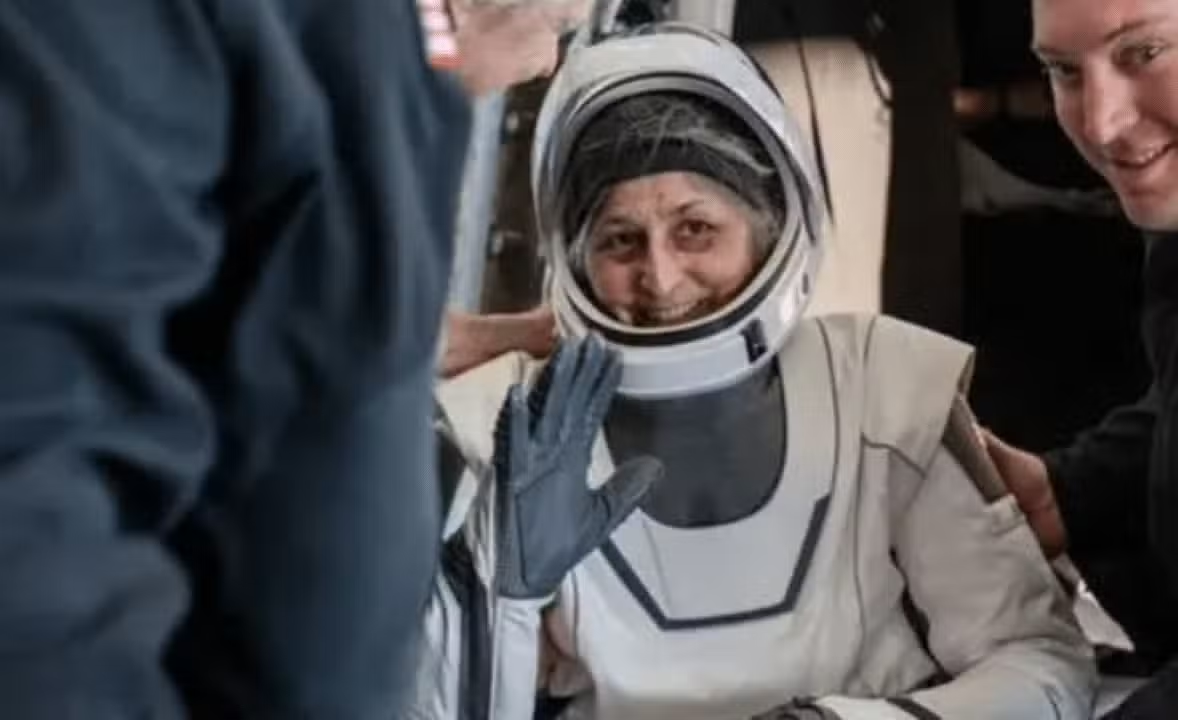
After a mission that stretched nearly ten months, NASA astronauts Sunita Williams and Butch Wilmore returned to Earth showcasing striking physical changes from their 286-day stay aboard the International Space Station (ISS). Launched in June 2024 for an intended eight-day test of Boeing’s Starliner capsule, the duo faced technical setbacks that extended their time in space, eventually returning on March 18, 2025, via SpaceX’s Crew Dragon. Their transformed appearances—marked by muscle loss and facial puffiness—captured public attention and reignited discussions about the effects of microgravity during prolonged space missions. Landing off Florida’s Gulf Coast, they now face a carefully monitored readjustment to Earth’s gravity, overseen by NASA experts.
Sunita Williams, 59, and Butch Wilmore, 62, both seasoned space travelers, arrived at the ISS expecting a short mission but ended up spending over nine months in orbit. During this time, they conducted around 150 scientific experiments, logging 900 hours of research in fields like space biology and aerospace medicine. Before-and-after photos, widely shared online, reveal swollen faces and slimmer bodies—common outcomes of zero-gravity exposure. Their extended stay provided a wealth of data, offering insights into how humans adapt to space, a critical factor as NASA plans future missions to the Moon and Mars.
Their return journey concluded with a successful splashdown at 6:57 p.m. Brasília time, following a 17-hour trip from the ISS. Accompanied by NASA’s Nick Hague and Russian cosmonaut Aleksandr Gorbunov, they were met by recovery teams and transported to Houston’s Johnson Space Center for medical evaluations. The toll of microgravity, combined with isolation and radiation exposure, means their recovery could take up to 45 days, according to NASA estimates, highlighting the physical demands of such missions.
Microgravity’s startling effects unveiled
Images of Sunita Williams and Butch Wilmore before and after their mission lay bare the dramatic ways microgravity reshapes the human body. Fluid redistribution in zero gravity causes a rounded, swollen face—often dubbed the “puffy face syndrome”—while legs thin out, earning the nickname “chicken legs” due to reduced muscle use. These temporary shifts, though striking, are well-documented among astronauts and typically reverse over time, yet they underscore the challenges of extended spaceflight.
In space, muscle mass can drop by up to 20% within two weeks, climbing to 30% over three to six months. To counter this, Williams and Wilmore adhered to a strict regimen of two-and-a-half hours of daily exercise on specialized bikes and treadmills. Despite these efforts, their return requires a phased rehabilitation program focusing on strength, balance, and endurance, guided by NASA’s medical team. The visible toll on their bodies serves as a testament to the harsh conditions they endured.
Bone health also takes a hit, with density decreasing by up to 1% per month in weight-bearing areas like the legs and spine. Supplements and resistance training mitigate some loss, but full recovery often spans months post-mission. Pictures of Wilmore grinning as he exited the capsule and Williams waving to cameras contrast with their noticeably weakened frames, reflecting both their resilience and the physical cost of their journey.
From short test to space odyssey
Initially planned as a brief Starliner evaluation, the mission ballooned into a 286-day stint due to technical glitches. Launched on June 5, 2024, Williams and Wilmore aimed to test Boeing’s new spacecraft, but thruster malfunctions and helium leaks made it unsafe for return. The Starliner landed uncrewed in New Mexico’s White Sands desert in September, forcing NASA to arrange an alternative ride home via the Crew-9 mission, launched in late September 2024 with the Crew Dragon Freedom.
The rescue craft, carrying Hague and Gorbunov, docked at the ISS with two seats reserved for Williams and Wilmore. Their departure from the station began at 2:05 a.m. Brasília time on March 18, 2025, followed by orbital maneuvers and a parachute-assisted descent into the Gulf of Mexico. Over nine months, they adapted to ISS life, contributing to experiments ranging from plant growth in microgravity to studies on radiation’s bodily effects—work deemed vital for future space exploration.
Williams, on her third spaceflight, brought extensive experience, now totaling 608 days in orbit, making her the second American astronaut with the most time in space, behind Peggy Whitson. Wilmore, a former Navy test pilot, leveraged his steady demeanor to navigate the unexpected extension. NASA hailed the mission as a success despite the hurdles, emphasizing the valuable data gathered for upcoming lunar and Martian expeditions.
Body and mind under the space lens
Spending nearly 300 days in space leaves lasting marks on both physique and psyche. Beyond muscle and bone loss, microgravity impacts the cardiovascular system, lowering aerobic capacity and orthostatic tolerance—the ability to stand without dizziness. NASA research indicates that long missions can impair balance, coordination, and spatial awareness, necessitating intensive post-flight rehab for astronauts like Williams and Wilmore.
Vision is another casualty. The Spaceflight-Associated Neuro-Ocular Syndrome (SANS) triggers optic nerve swelling and eyeball shape changes due to fluid buildup in the head. While most cases resolve on Earth, extended missions heighten the risk of lasting damage. NASA equips the ISS with specialized glasses to lessen this, and the duo’s eye health remains under close watch during recovery.
Mentally, the prolonged isolation tests endurance. Williams and Wilmore maintained structured routines—work, exercise, and regular Earth check-ins—to stay grounded. Their veteran status likely eased the strain of extra months away from family, showcasing the mental fortitude required for such missions.
Key milestones of an unexpected journey
The mission unfolded with twists that reshaped its timeline. Here’s a rundown:
- June 5, 2024: Starliner launches with Williams and Wilmore for an eight-day ISS test.
- June 2024: Technical issues emerge, delaying their return indefinitely.
- September 2024: Starliner returns empty; NASA pivots to Crew-9 rescue plan.
- September 29, 2024: Crew Dragon Freedom launches with Hague and Gorbunov.
- March 18, 2025, 2:05 a.m.: ISS undocking kicks off the journey home.
- March 18, 2025, 6:57 p.m.: Splashdown in the Gulf of Mexico ends 286 days in space.
These milestones highlight the unpredictability of spaceflight and the need for swift adaptation.
Readjusting to Earth’s pull
Post-splashdown, Williams and Wilmore were whisked to Johnson Space Center for comprehensive health checks. Recovery, potentially lasting six weeks, involves exercises to rebuild muscle, balance, and stamina. NASA notes most astronauts regain full fitness within 45 days, though their extended stay might stretch this timeline slightly.
Fluid shifts causing facial puffiness begin normalizing within three days on Earth, but back pain, dizziness, and standing difficulties linger initially. Medical teams track vital signs and eye health to ensure a smooth transition. A brief observation period precedes family reunions, a standard step after long missions, with their experiences feeding into studies on extended spaceflight effects.
Their return marks the start of a new phase—reacclimating to gravity while contributing data for NASA’s Artemis program, which aims to return humans to the Moon. The physical toll they endured underscores the resilience required for such feats, offering a glimpse into the realities of space travel.
Space lessons for tomorrow
The mission shines a spotlight on long-term spaceflight challenges. The 150 experiments conducted tackled human health, food growth, and tech advancements, yielding insights for future missions. Radiation exposure, which raises cancer risks and accelerates cellular aging, remains a key concern, with their data helping refine protective measures.
Strategies to safeguard astronauts include:
- Daily two-and-a-half-hour workouts to preserve muscle and bone.
- Calcium and vitamin D supplements to combat bone loss.
- Regular vision checks with onboard equipment.
- Ongoing psychological support to counter isolation.
Their ordeal exposed Starliner’s flaws but affirmed NASA and SpaceX’s problem-solving prowess. The successful Crew Dragon rescue bolsters confidence in contingency planning, a cornerstone for upcoming lunar and Martian ventures.