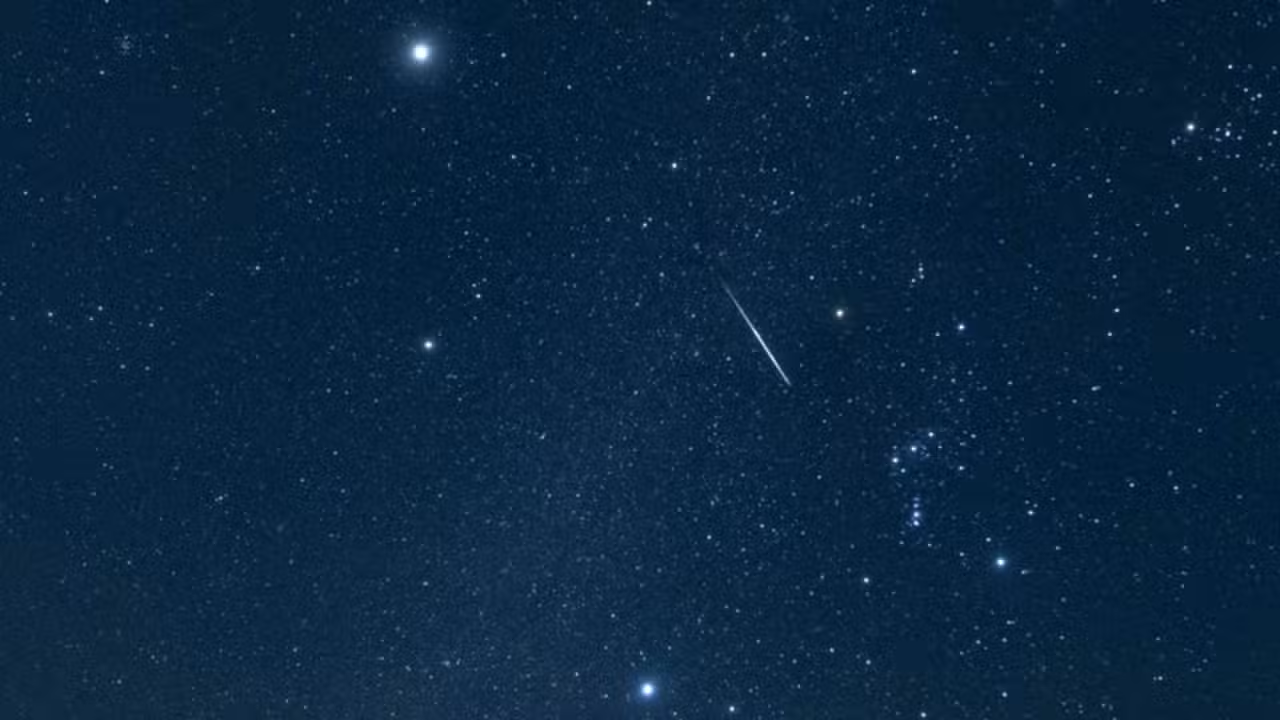
NASA announced that asteroid 2025 PN7, discovered in 2025 by the University of Hawaii, is a quasi-moon of Earth, shadowing the planet in its solar orbit. Estimated to be 18 to 36 meters in diameter, the celestial object follows a path nearly identical to Earth’s but is not gravitationally bound to it. Detected during a routine telescope survey, the asteroid has been orbiting in sync with Earth for about 60 years. It will remain a companion until 2083, when it will drift away.
The 2025 PN7 approaches Earth within 4 million kilometers at its closest, ten times farther than the Moon, and reaches 17 million kilometers at its farthest. The discovery enhances the study of near-Earth objects and their movements. Only eight quasi-moons have been confirmed so far, underscoring the rarity of the phenomenon.
- The asteroid was spotted in 2025 by University of Hawaii telescopes.
- Its orbit is influenced by the gravity of the Sun and nearby planets.
- NASA monitors the object to refine orbital models and plan future missions.
Discovery in Hawaii
The identification of 2025 PN7 occurred during a routine survey by the University of Hawaii. Astronomers noticed a faint speck moving in sync with Earth, prompting detailed analysis. After weeks of observation, NASA confirmed the asteroid tracks Earth’s orbit, classifying it as a quasi-moon.
Asteroid characteristics
The 2025 PN7 is small, comparable to a multi-story building. Its elliptical orbit keeps it stable but not directly tied to Earth’s gravity. Its distance, varying between 4 and 17 million kilometers, results from interactions with solar and planetary gravity. The asteroid’s stable orbit makes it a potential target for future studies. Researchers note its path aids in understanding near-Earth object behavior.
Scientific significance
Quasi-moons like 2025 PN7 are rare and provide valuable data on orbital dynamics. These objects help improve predictions about near-Earth asteroids, critical for planetary safety. NASA considers such bodies potential targets for space missions due to their accessibility and stability. Studies of 2025 PN7 may advance space exploration technologies. The discovery highlights the need for continuous monitoring of near-Earth space.
Ongoing monitoring
NASA keeps 2025 PN7 under observation to map its trajectory precisely. Collected data help predict the behavior of similar asteroids. Monitoring also assesses potential risks, though the asteroid poses no threat.
Future of quasi-moons
The 2025 PN7 will stay with Earth until 2083, when its orbit will take it away. Its departure will not affect the planet, but its presence offers a unique scientific opportunity.
Contributions to space missions
The relative proximity of 2025 PN7 makes it an ideal candidate for testing space technologies. Future missions may use it for experiments, leveraging its stable and accessible orbit. Its discovery underscores the importance of astronomical monitoring programs.