The impact of Assassin’s Creed Black Flag Resynced with reworked naval combat and exploration By Maria
6 min read
 |
Recently released to a global audience, Assassin’s Creed Black Flag Resynced arrived on the electronic games market with the fulfilled promise of recreating one of Ubisoft’s biggest hits. Different from a simple visual update, the developer chose to rebuild the entire technological foundation of the pirate adventure that marked the industry in 2013. The programming team managed to preserve the soul of eighteenth century maritime exploration, while applying modern mechanics that perfectly match the demands of today’s players.
During gameplay sessions of this new version, one quickly realizes that the balance between nostalgia and innovation dictates the pace of the campaign. The main plot has undergone a clever restructuring, drastically shortening the old and often criticized missions in the present tense. Instead of focusing on Abstergo’s corporate offices, the script now delves deep into protagonist Edward Kenway’s past, using fragmented memories to explain his motivations before donning the assassins’ cowls.

This change in narrative focus allows users to spend much more time enjoying the Caribbean atmosphere without sudden interruptions. Interactions with historical figures from the Golden Age of Piracy gained extra dialogue, strengthening the immersion in a world where the law of the seas prevails. Every detail of the environment was designed to maintain the feeling of absolute freedom that established the original work more than a decade ago.
The evolution of physical confrontations and the importance of synchronized defense
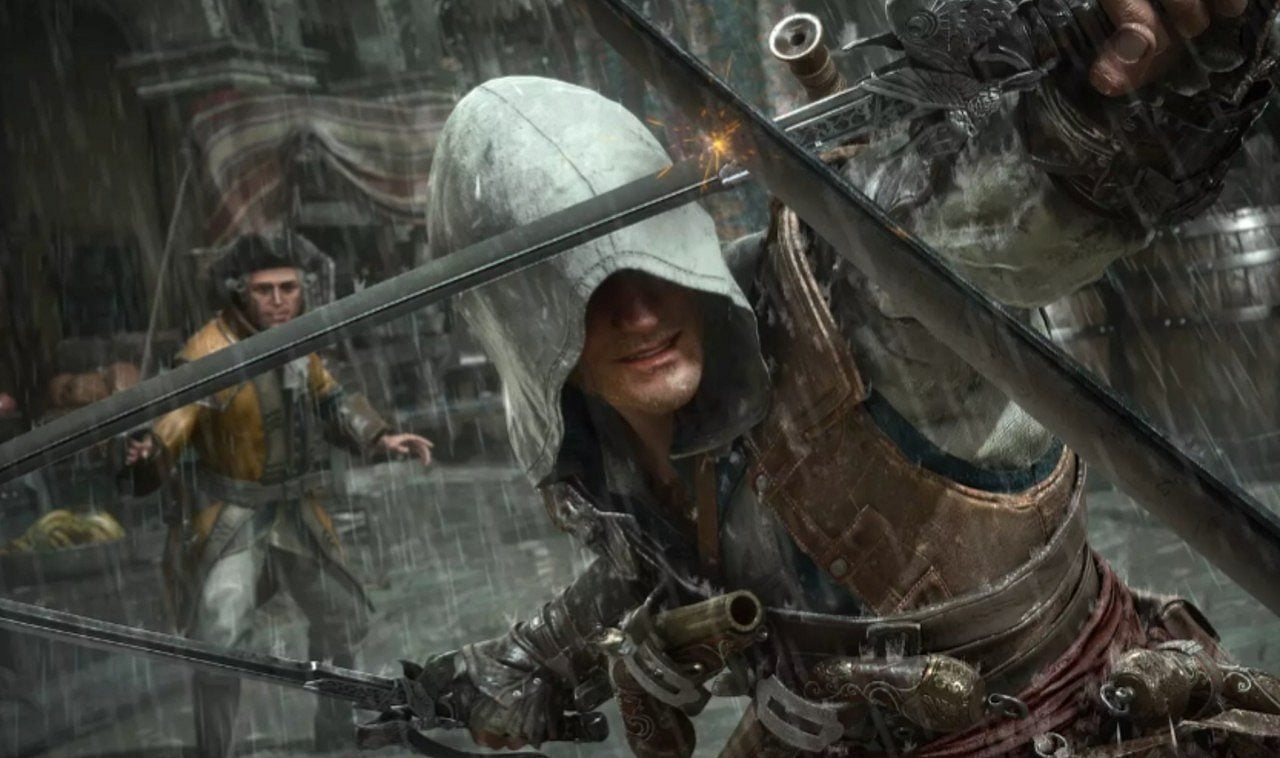
The melee system has undergone a drastic overhaul, abandoning the old model of automatic counterattacks to adopt a much more technical approach. Now, perfect blocking at the exact moment of enemy impact acts as the core of ground battles. Being able to deflect the opponent’s blade in the correct fraction of a second creates huge gaps for cinematic finishes, requiring accurate reflexes from whoever holds the control.
For moments when precision fails, the title offers tactical alternatives based on the physical wear and tear of opponents. Pressing a soldier’s guard repeatedly causes his energy bar to deplete, opening the way for brutal blows that break the defensive posture. This extra layer of strategy prevents combat from becoming repetitive, forcing the privateer to read the movements of each type of royal guard that crosses his path.
Edward’s inventory of offensive tools has also received considerable additions to deal with different threats. In addition to the classic pair of swords and the famous hidden blades, the pirate now performs dynamic sweeps, kicks to fend off armored enemies and uses an arsenal of firearms with improved reloading. Although artificial intelligence tends to send massive groups of opponents simultaneously, which can cause slight fatigue in larger fortresses, the variety of resources available ensures that the player always has an ace up their sleeve to survive.
Urban movement completely rebuilt to ensure agility
One of the biggest technological leaps in this recreation is found in the way the character interacts with the architecture of colonial cities. The free-running mechanics have been rewritten from the ground up, delivering directional precision that eliminates the old frustrations of accidentally jumping the wrong way. The current graphics engine understands the user’s intent clearly, allowing for smooth transitions between rooftops, balconies, and ropes strung across clay streets.
Virtually any surface visible on the horizon can be climbed with unprecedented and extremely realistic animations. The design of the urban settings has been subtly altered to include more support poles, cargo cranes, and stacked crates, creating natural escape routes that keep the flow of the chase uninterrupted. This fluidity transforms the simple action of crossing a village into a highly pleasurable and visually impressive activity.
Outside of cities, exploration of dense jungles and ancient ruins follows the same standard of acrobatic excellence. Tree branches and rock formations connect organically, allowing aerial assassinations to be planned in advance and executed with a lethal grace that defines the essence of the secret brotherhood.
Dominance of the oceans and the firepower of ships
Sailing through the crystal clear waters of the Caribbean remains the beating heart of the experience, but now with fluid physics that borders on photorealism. The legendary Gralha ship responds to helm commands with a weight befitting its colossal size, requiring anticipation in maneuvers. Wind direction directly affects cruising speed, forcing the captain to constantly adjust the sails to avoid becoming an easy target during tropical storms.
The atmosphere on board is enriched by the triumphant return of the famous sailors’ songs, which echo across the deck as the crew works on rigging. When the calm gives way to the chaos of naval warfare, the player must manage a complex and highly destructive artillery system. The Gralha was equipped with a set of armaments that covers all distances of maritime combat:
- Side gun batteries for devastating close-range volleys.
- Explosive barrels launched from the stern to lose pursuers.
- Iron chains fired from the bow to tear enemy sails and immobilize targets.
- Long-range mortars that deal area damage even before direct visual contact.
Each ship’s equipment has alternative ammunition that completely changes the tactical approach against the Spanish and British fleets. Knowing the exact moment to order the crew to take cover from enemy fire drastically reduces damage to the hull, being a vital mechanic for surviving clashes against the feared war galleons.
Geographic positioning during naval battles requires constant reading of the environment. Using coral islands as natural shields or luring larger vessels into shallow waters demonstrates how the game design rewards tactical intelligence over brute strength, making every victory at sea a memorable achievement.
Art direction revitalizes the paradisiacal landscapes of the time
The visual spectacle delivered by Ubisoft’s new engine reaches its peak when graphics are configured to their maximum capacity on modern computers. The color palette abandoned the grayish tones of the seventh generation of consoles to embrace the authentic tropical vibe. The deep blue of the ocean contrasts perfectly with the white sand of the pristine beaches, while the refraction of sunlight in the water creates scenes worthy of classical paintings.
Iconic cities like Havana and Kingston were meticulously rebuilt brick by brick. The dirt of the streets, the wear and tear of colonial buildings and the invasive vegetation that takes over the Mayan ruins have received very high resolution textures. This extreme care with the art direction not only serves as eye candy, but acts as a constant invitation for the player to ignore the main missions and just explore each hidden island on the map.
The Animus legacy and the impact of its market launch
Even as sequels dwindle in the modern world, the franchise’s sci-fi identity remains rooted in the user interface. The classic glitch screen, which displays the desynchronization message with genetic memories, returns with improved digital glitch effects. This subtle detail confirms that, despite all the innovations, the project still respects the fundamental rules of the universe created around the Animus machine.
Available since the beginning of June, the title is already demonstrating its strength in player communities and discussion forums. The French producer’s decision not to change the essence of the work, focusing only on improving what already worked, proved to be an extremely successful commercial strategy. The historical recovery of the privateer figure, combined with polished gameplay, places this launch as one of the biggest milestones in digital entertainment this year.
By delivering a complete adventure free of serious technical problems on the first day, the company managed to restore the confidence of a fan base that longed for a return to its origins. Edward Kenway’s journey proves that good stories, when combined with cutting-edge technologies and respect for the original material, have a timeless appeal capable of winning over both veterans and a new generation of virtual sailors.