

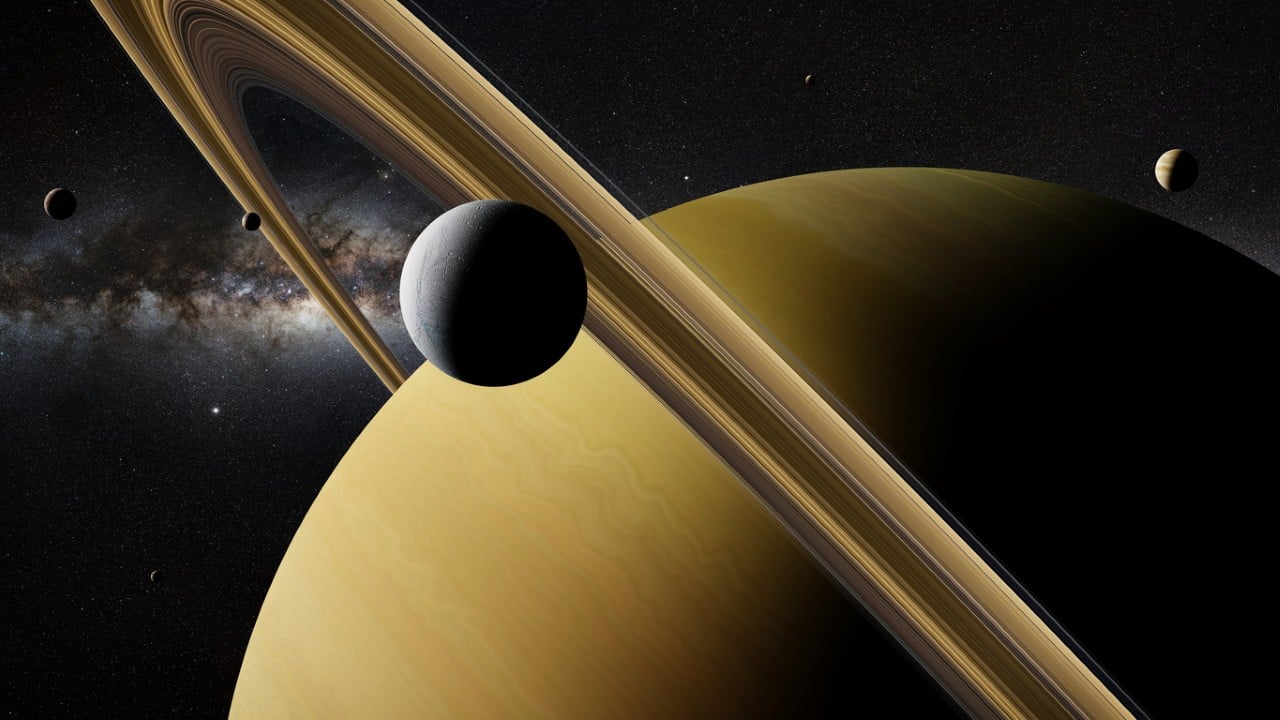
Titan, Saturn’s largest moon, has a surprisingly dense atmosphere and oceans of methane, making it the only celestial body outside Earth where a human could survive outdoors without the need for a pressurized space suit.
The surprising atmospheric pressure on the moon Titan
The main reason why Titan stands out is its ability to allow the human body to withstand external pressure without the aid of special clothing. Although the vacuum is not a problem, extreme weather conditions, with freezing temperatures, would require high-performance thermal clothing to guarantee survival.
Titan’s surface has an atmosphere with a pressure approximately 50% higher than that found on Earth at sea level. This atmospheric density is crucial for keeping bodily fluids stable, protecting us from the harmful effects of low space pressure seen on other celestial bodies such as Mars and the Moon.
More on this story: How the moon Titan, with rivers and methane rains, reveals a scenario identical to that on Earth
In contrast, in places like Mars or the Moon, the thin or nonexistent atmosphere would lead to asphyxiation and require pressurized suits to keep bodily fluids from boiling. On Titan, however, the environment naturally provides the necessary support for the human organism, drastically differentiating it from its neighbors.
Lethal dangers on the surface of the moon Titan
Even with adequate atmospheric pressure, Titan’s surface presents dangers that would be fatal in mere seconds without specific equipment. Temperatures, for example, reach a frigid minus 179 degrees Celsius across much of its length.
Learn more: Titan, Saturn’s moon, has a unique atmosphere where humans do not need a space suit
In addition to the extreme cold, the gaseous composition of the atmosphere is highly toxic to the human respiratory system. Predominantly made up of nitrogen and methane, it offers none of the essential oxygen elements needed for terrestrial life.
Characteristics of Titan’s lakes and rivers
Unlike Earth, where water is the main component of rivers and seas, Titan has vast liquid expanses composed of methane and ethane. Specific environmental conditions ensure that these hydrocarbons remain in a liquid state, creating hydrological cycles similar to those on our planet.
Among the most unusual features found on Titan’s soil, the following stand out:
On the same topic: Hydrological cycle of Titan, Saturn’s moon, reveals methane rivers in deep ice setting
- Methane storms that feed rivers and large lakes year-round.
- Dark dunes composed of grains of heavy hydrocarbons, shaped by the action of winds.
- A crust of water ice that behaves like rock due to its hardness and rigidity.
- An extremely low gravity, representing only 14% of Earth’s gravitational force.
Possibility of human flight on Titan with wings
Titan’s dense atmosphere combined with low gravity creates unique physical conditions that intrigue flight enthusiasts. Theoretically, with the use of mechanical wings attached to the arms, an individual could take off and fly with relative ease, using only their own muscular strength after a brief run.
To understand how this human flight would become a reality, it is necessary to analyze the following environmental data:
- Environmental comparison with planet Earth:
- – Atmospheric density: The air on Titan is approximately four times denser than that on Earth, providing a significant increase in thrust over any aerodynamic surface (4x denser).
– Gravitational force: Local gravity corresponds to about one-seventh of that of Earth, resulting in a much lower apparent weight, which would allow for higher and longer jumps (1/7 of Earth’s gravity).
NASA space agency plans for Titan
The North American space agency NASA has ambitious plans for Titan, including sending the Dragonfly mission. This initiative envisages the exploration of the region by an autonomous, nuclear-powered drone, with the primary objective of investigating the complex organic chemistry that could be a precursor to the development of life.
Although the environment is inhospitable to direct human presence, Titan holds crucial secrets about planetary origins and evolution that could offer insights into Earth’s own past. Continued research into this distant star is critical to deepening our understanding of the diversity and formation of worlds in our solar system.