TESS satellite captures interstellar comet 3I/ATLAS escaping from the Solar System

The TESS satellite recorded unprecedented images of the interstellar comet 3I/ATLAS as the object moved away from Sistema Solar. The unplanned observation took place in January 2026 and revealed chemical and physical characteristics considered rare by the international scientific community. Data collected during 28 hours of continuous monitoring made it possible to compile a video showing the comet as an accelerated moving point of light against the stellar background.
The initial detection of the object in the TESS files dates back to May 2025, months before its official identification. Naquela time, the comet remained inactive and almost indistinguishable from the surrounding stars, showing minimal reflectivity that made it difficult to locate.
Descoberta accidental during exoplanet monitoring
TESS identified comet 3I/ATLAS by chance while carrying out its routine monitoring of sectors of the sky. The spacecraft captured the object in several observation sessions originally intended to search for exoplanets orbiting other stars. Scientists recovered archived images that showed the comet as early as May 2025, when it had low activity and virtually zero reflectivity.
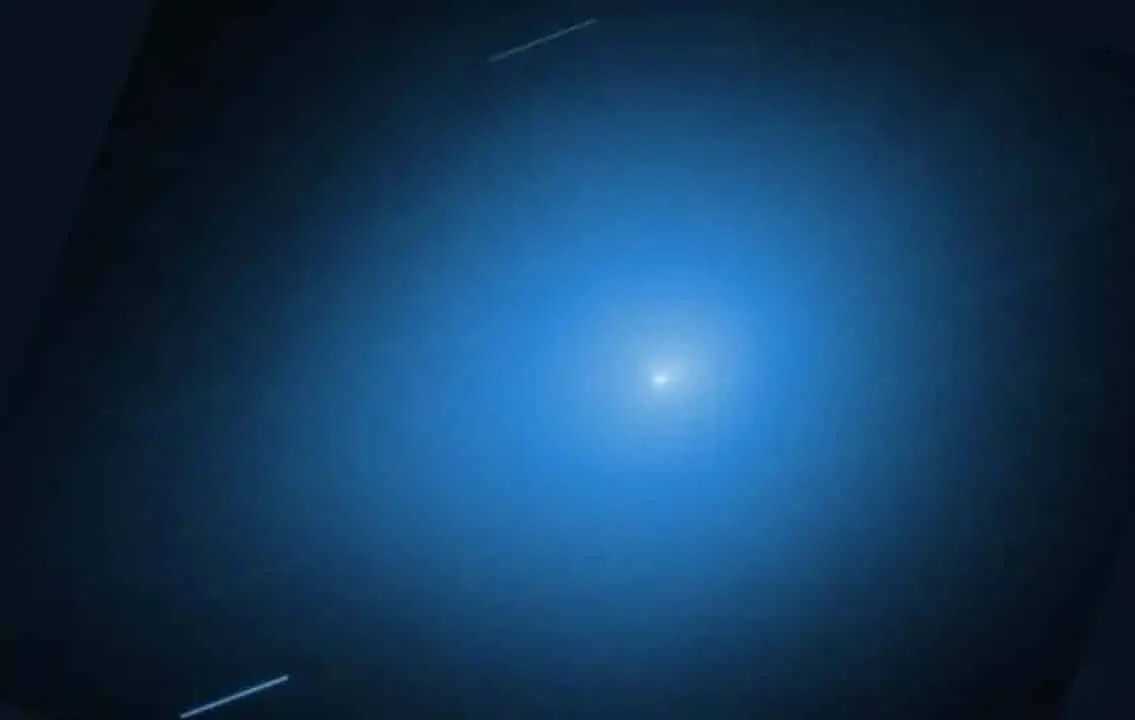
Rare Estrutura with tail pointing to Sol
An unusual structure called a countertail was observed in TESS images during closest approach. Esse dust trail points in the direction of Sol, behavior contrary to what is expected from conventional cometary tails that move away from the star. The countertail indicates a specific interaction between the released particles and the pressure of solar radiation, a phenomenon that helped confirm the interstellar nature of the object.
Learn more: Astronomical phenomenon dyes the Moon red in the skies of Brazil in August 2026
Massive Núcleo with extreme features
The core of 3I/ATLAS is estimated to be approximately three kilometers in diameter, making it more massive than the two previous confirmed interstellar visitors. Complementary Observações telescopes Hubble and James Webb confirmed its dark and icy nature, with extremely low reflectivity comparable to that of asphalt surfaces. Essa characteristic significantly hampered its initial detection in conventional ground-based observations.
- Diâmetro from the core: approximately 3 kilometers
- Refletividade: extremely low, similar to asphalt
- Composição: ice and rocks of interstellar origin
- Massa: superior to previous interstellar objects
Composição carbon dioxide dominated chemistry
Spectral analysis revealed a predominance of carbon dioxide in emissions during the closest approach to Sol in October 2025. Esse gas represented around 87% of the material released, a proportion inverted in relation to Sistema Solar comets, which normally have water as the main component. The presence of water was limited to no more than 4% of total emissions, drawing researchers’ attention due to the compositional anomaly.
See Also

Oblivion Remastered for Switch 2: game divides opinions between improved visuals and performance issues

Polish art world loses Jan Frycz, iconic theater and film actor, aged 72

Blizzard prepares Diablo 4 launch for Switch successor in September
Methane was detected only after perihelion, a phase in which the comet was already moving away from Sol. Antes from this stage, no trace of the gas had been recorded in previous observations, suggesting a complex internal structure in the core. Cometary activity decreased dramatically in just 12 days after the closest pass, a marked contrast to patterns observed in local comets that maintain prolonged activity.
On the same topic: Observing Comet PanSTARRS Requires Predawn Hurry in April
Hipóteses on protective crust and delayed methane release
One proposed explanation points to the formation of thick crust during billions of years of exposure to cosmic radiation. Essa layer would have insulated the internal methane ice until sufficient warming during solar approach. Heat gradually penetrated the outer crust along the trajectory near Sol, releasing methane trapped in the deep layers of the core. Outra possibility involves direct chemical reactions in the heated dust cloud, which would have generated methane in situ during the phase of greatest thermal activity.
Fenômenos observational and comparison with previous visitors
The comet’s brightness increased significantly on January 22, 2026, when the object, Terra, and Sol were aligned in a specific configuration. The phenomenon known as the opposition effect explains the peak luminosity observed in this particular geometry. 3I/ATLAS is the third confirmed interstellar object after ‘Oumuamua and comet Borisov, each presenting distinct characteristics in composition and behavior. Enquanto ‘Oumuamua exhibited a hyperbolic trajectory with no visible cometary activity and Borisov showed a classical tail rich in water and cyanide, 3I/ATLAS combines elements of both with a predominance of carbon dioxide, offering a unique opportunity for comparative study.
Combined Dados and definitive exit trajectory
The TESS data complemented observations of Hubble and James Webb at different wavelengths, allowing for more complete characterization of the object. The information collected contributes to the understanding of the formation of distant planetary systems, with the chemical composition suggesting specific conditions in the comet’s home system. 3I/ATLAS follows the hyperbolic trajectory of Sistema Solar’s definitive exit, with its current speed preventing any future return to the inner region. Continuous Observações tracks the object as it recedes, with the final data helping to refine models of interstellar dynamics.
More on this story: Passage of celestial body Tempel 2 reveals historic trail of space dust