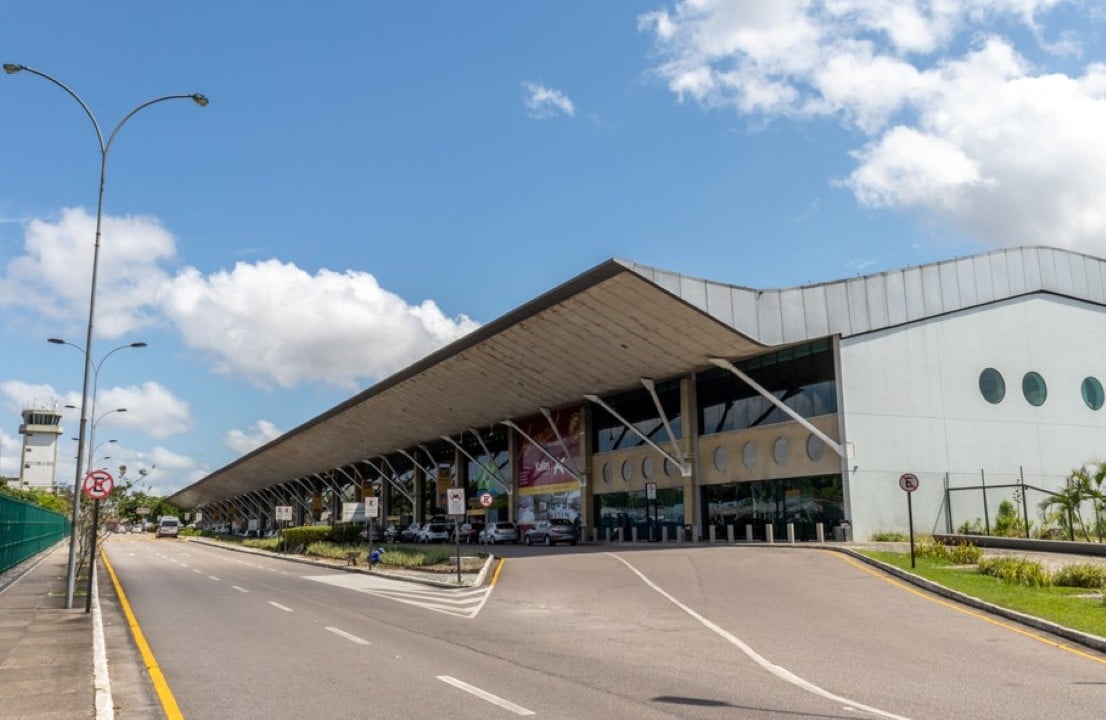
A citizen of Sierra Leone has been residing for approximately six months at Belém International Airport, Pará, after being unable to travel to Panama. The woman had her passport stolen in the capital of Pará, which prevented her from continuing her trip.
Fatmata Sessay, 56, has slept daily in the terminal lobby and eaten her meals in a municipal shelter. However, she received a ticket from the Public Ministry of Pará to travel to Panama next Monday, the 22nd. The news generated great emotion in Sessay.
“No one helped me here. It was just you who bought my ticket. Thank you very much. God willing, I will find my son and start my life over again”, Sessay expressed to prosecutor Nadilson Portilho, responsible for monitoring her case.
Series of difficulties prevented the continuation of the trip to Panama
Fatmata Sessay, 56 years old, received a ticket from the state Public Prosecutor’s Office to travel on Monday, the 22nd.
“We arranged for her to purchase a ticket for June 22nd, until then we will accompany her to arrange her visa and international vaccination card so that she can continue her journey”, informed the prosecutor.
On the night of Friday, the 19th, the Federal Court in Pará accepted a request from the Federal Public Ministry (MPF). The court decision determined that both the state government and Itamaraty must offer consular assistance so that Sessay can obtain the necessary documents within 48 hours.
Sessay’s journey to arriving at the Belém airport lounge presents points that are difficult to understand, partly due to the immigrant’s communication barrier. Sierra Leone’s official language is Kriô, and she has difficulty expressing herself in Portuguese and other languages.
She says she left São Paulo, where she lived for 18 years, at the end of last year, heading to Panama, to find her 15-year-old son.
Fatmata Sessay, 56, from Sierra Leone, improvises a place to sleep at Belém Airport; She has remained in the terminal since December, after her passport was stolen.
Traveling alone, the woman reports that she was the victim of a robbery in Peru and that she managed to continue her journey with the help of volunteers. From there, she went to Suriname and then embarked for Belém.
“I was robbed and people helped me. I arrived in Suriname and they bought a ticket to Belém saying it would be easier to get a ticket to Panama from here”, explained Sessay.
In Belém since December of the previous year, she suffered a new robbery, in which her passport was stolen and she lost a donated ticket to Panama, scheduled to board on April 16th.
“I managed to buy the Belém-Bogotá-Panama ticket and I showed my cell phone to the man to stamp it, and he took the passport from my hand and didn’t give it back to me”, reveals Fatmata.
The details of this robbery are not completely clear. The report sought information from the Federal Police, but received no response. The State Public Prosecutor’s Office, which also assists the immigrant, reported that the PF is investigating what happened.
“What is known is that she was stolen and, therefore, was unable to board. But the case is being investigated,” said prosecutor Nadilson Portilho.
Despite all the adversities, she managed to issue a new passport in Belém. Without financial resources to continue the trip, Fatmata started to live at the airport.
“I sleep here on the floor. During the day I go to Centro Pop [Specialized Reference Center for the Homeless Population] to eat and take a shower. The city hall also registered me with Bolsa Família”, he says.
Belém City Hall confirmed that Fatmata Sessay has been monitored by social assistance teams since December 2025 and that she receives daily food in the reception space. She also became a beneficiary of Bolsa Família.
According to the municipal body, the immigrant refused to go to the night shelter service that serves homeless people. The city hall justifies that it follows the guidelines of the national assistance policy, which does not allow compulsory reception.
“I didn’t want to go anywhere because when I go out there are people and cars on top of me. Here [at the airport] I feel safe,” she said.
Judge Maria Carolina Valente do Carmo, from the 1st Federal Civil Court of the Federal Court, accepted on Friday, the 19th, the request from the Federal Public Ministry. The decision determines that the Government of Pará and the Ministry of Foreign Affairs provide consular assistance to the migrant within two days. The objective is to carry out the necessary procedures with the diplomatic representation of Sierra Leone, based in Washington, to regularize travel documents and obtain visas to enter Colombia and Panama.
The Prosecutor’s Office maintains that there was negligence on the part of the authorities in all spheres, and that the woman is in a situation of high social vulnerability. This type of judicial intervention, highlighting the omission of public authorities, is crucial to ensure that migrants in fragile conditions are not abandoned, reinforcing the state’s responsibility in guaranteeing a minimum of dignity and support on Brazilian soil.
“We see in this case both xenophobia and racism, because if it had been a tourist from Europe, this would not have happened. So much so that, during COP 30, the post operated normally and was only reopened after the court decision”, argued the regional prosecutor for citizens’ rights, Sadi Machado, author of the request.
The State Secretariat for Justice (Seju) reported that it provided assistance to the Sierra Leonean citizen in May. A team referred them to the Papa João 23 Foundation to guarantee access to reception and assistance services.
Regarding consular assistance, Itamaraty recommended that contact be made with the immigration authorities at Belém airport.
Since the case gained prominence in the media, several people have approached the airport to offer housing and food to the migrant.
“I saw the case in the press and came to offer her my house. If she wants to stay there until she can travel, I can provide accommodation and food. We play the role that the public authorities should play”, declared housewife Carla Livramento.