Solar eclipse, meteor shower and strong El Niño mark week of scientific advances
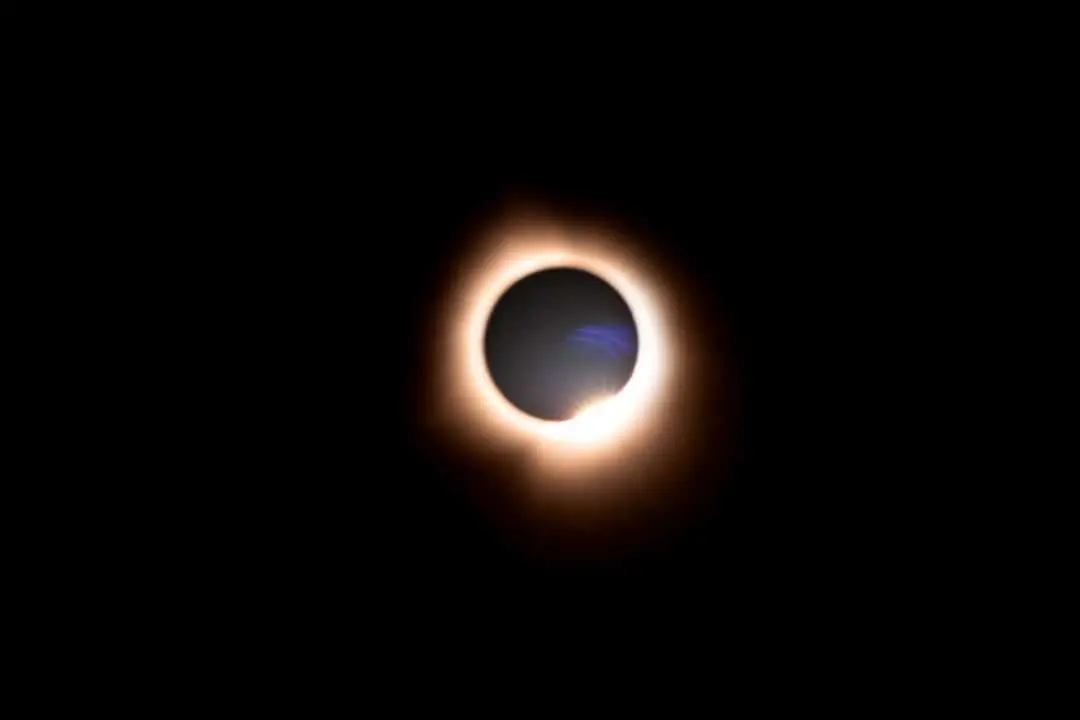
A total solar eclipse could be witnessed in regions of Europe, such as mainland Spain, on August 12, 2026. For the European country, it was a notable event, as phenomena of this nature had not occurred since 1905.
However, the expectation for the next total solar eclipse will not require an extended period.
Seeing a total solar eclipse from the same location is among the most unusual astronomical occurrences. NASA calculates that a specific area of the planet takes, on average, 375 to 400 years to experience such an event, although this estimate is not a constant and the waiting period can vary significantly.
The explanation for this rarity lies in the restricted size of the lunar shadow. During a total eclipse, the darkest portion of this shadow, called the umbra, usually measures between 100 and 200 kilometers wide. As the Moon circles the Earth and the planet rotates, this umbra quickly travels across the surface, generating a tiny band called the corridor of totality.
Since most of the globe remains outside this path, witnessing the complete darkness of one’s own location requires an exceptional conjunction of geographic factors. The trajectory of these phenomena also differs with each occurrence. Eclipses from the same series, for example, follow the Saros Cycle, which manifests itself every 18 years, 11 days and eight hours. The additional eight hours correspond to an extra rotation of the Earth, changing the area affected by the subsequent eclipse to another part of the planet.
More on this story: Celestial phenomena of 2026: know when to view eclipses, supermoons and meteor showers
This dynamic elucidates the reason why certain locations experience an atypical sequence of eclipses, while others remain centuries without observing any. Carbondale, in the United States, for example, had the unusual occasion of witnessing total eclipses in 2017 and 2024, just seven years apart. On the other hand, London, England, had a gap of 837 years between the events of 878 and 1715.
Calendar for upcoming solar eclipse events
Following the recently observed eclipse, the next total solar eclipse is predicted for August 2, 2027. The corridor of totality will span regions of Spain, North Africa, the Middle East and the Indian Ocean, including nations such as Morocco, Algeria, Tunisia, Libya, Egypt, Saudi Arabia, Yemen and Somalia. Gibraltar will also be on the route, as will portions of the Atlantic and Mediterranean oceans.
In Brazil, however, this 2027 phenomenon will be almost imperceptible. Only a small area of Rio Grande do Norte will be able to see a partial eclipse, with an estimated occurrence between 5:12 am and 5:38 am, Brasília time. At this point, less than 1% of the solar disk will be obscured by the Moon.
Expectations for the total solar eclipse in Brazil
The long-awaited arrival of a total solar eclipse in the national territory has already been going on for a long period: the last event of this type witnessed in Brazil occurred on November 3, 1994.
Learn more: Skywatchers have 8 highlights in July 2026 with meteor showers and Milky Way
The next opportunity to observe this phenomenon will only be on August 12, 2045. The band of totality should cover, above all, the North and Northeast regions, crossing capitals such as Belém, São Luís, João Pessoa and Recife. In certain locations, the Sun may be completely hidden for more than four minutes.
However, it will not be necessary to wait such an extended period to contemplate other types of eclipses. On February 6, 2027, parts of Brazil will have the chance to observe an annular eclipse, known as the “Ring of Fire”, an event that was also visible in 2023. Additionally, on August 2, 2027, a partial solar eclipse will be visible in the country.
The Future of Total Solar Eclipses: A Look at What’s to Come
In more than 600 million years, the Earth will no longer witness one of the greatest celestial spectacles. A modification already underway, although imperceptible to humanity, will permanently transform the alignment between the Sun, Moon and Earth.
The occurrence of a total solar eclipse depends on an astronomical coincidence: seen from planet Earth, the Moon has an apparent size very similar to that of the Sun. However, the outcome of this alignment changes depending on the distance of our natural satellite in relation to the planet.
See Also

Understand which plants in your garden attract scorpions and how to protect yourself

Motorola Edge 50 cell phone becomes cheaper and bets on military resistance to attract sales

Apple’s smart watch reaches historic lowest price abroad and attracts Brazilians
In a partial eclipse, only a portion of the star is obscured. In the annulus, the Moon is further away and appears insufficient to completely cover the solar disk, resulting in a ring of visible light. In total, the Moon completely hides the Sun for those in the area affected by the densest shadow, exposing the solar corona. There is also the hybrid eclipse, a rare form in which the event oscillates between annular and total, depending on the position of the observer.
The central issue is that this dynamic is changing as the Moon moves away from Earth. Given the elliptical orbit of the natural satellite, the current separation fluctuates from around 356 thousand kilometers at perigee (point of greatest proximity) to more than 406 thousand kilometers at apogee (point of greatest separation).
Measurements carried out with lasers directed at reflectors implanted on the lunar surface by Apollo missions confirm that the natural satellite moves away from the planet by an average of 3.8 centimeters each year. This displacement is the result of the gravitational interaction and tidal forces between the Moon and the Earth.
On the same topic: Five meteor showers light up the sky in 2026 with peaks in April, August, October, November and December
El Niño forecast with high intensity for the coming months
The United States Oceanic and Atmospheric Administration (NOAA) raised the chance of the El Niño phenomenon reaching a very strong intensity between October and December 2026 to 95%. The new estimate was presented in an update published on August 13, 2026.
In the previous report, released on July 9, 2026, the same agency had calculated the probability of El Niño reaching this intensity level for the same period at 81%.
For the time span between November 2026 and January 2027, which includes the end of spring and the beginning of summer in the Southern Hemisphere, NOAA currently projects a 90% chance of a very high intensity El Niño.
NOAA also predicts a 69% probability of this event ranking among the largest El Niños documented since 1950, based on current projections for Pacific Ocean temperatures.
This update comes at a time when the warming of the waters of the Equatorial Pacific is continuously accelerating.
More on this story: Mercadante warns of intense El Niño and BNDES mobilization in climate emergencies
Discovery of mysterious object challenges astronomy
Astronomers from the Massachusetts Institute of Technology (MIT) have identified an extremely luminous object with a reddish hue in the early universe. It can be classified as a new type of astrophysical body, called a “black hole star”.
The object, observed by the James Webb Space Telescope, resembles a star of gigantic proportions, however, it emits energy of a magnitude similar to that of a black hole. The revelation may also help in understanding the enigmatic “small red dots” seen in records from the distant universe.
Perseid meteor shower gifted global observers
Every year, between mid-July and the end of August, planet Earth intercepts the cloud of debris left by comet 109P/Swift-Tuttle. When these fragments penetrate the Earth’s atmosphere, the Perseid phenomenon occurs, a meteor shower that is more easily seen in the Northern Hemisphere, but can also be observed, to a lesser extent, in nations south of the equator, such as Brazil. Visibility depends on favorable weather conditions and the least possible presence of light pollution.
Recently, the peak of this meteor shower occurred between the night of August 12, 2026 and the early morning of August 13, 2026. The Moon, being on the first day of the new phase, provided a privileged view of the Perseids — named because they originate in the constellation of Perseus. This made it possible for observers from different parts of the world to not only appreciate the event, but also make impressive records of the phenomenon.