Curiosity discovers sea of polygons on Mars, but has damaged wheel
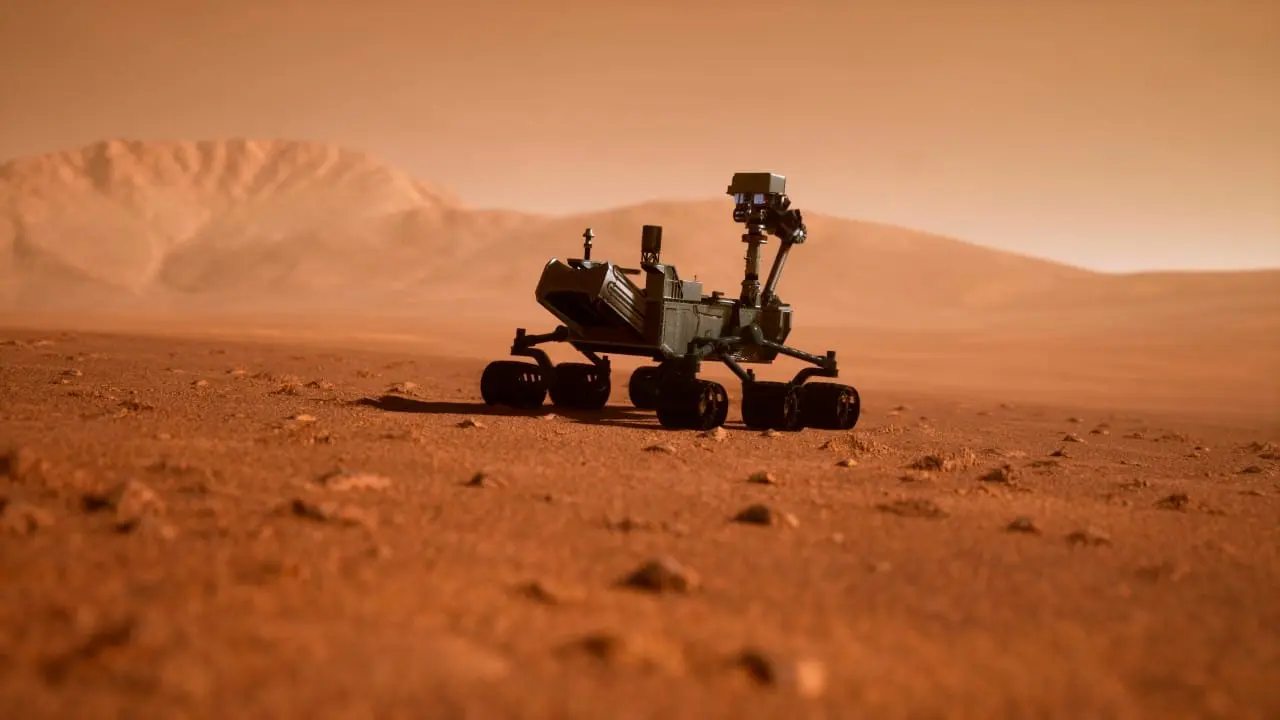
NASA’s Curiosity probe has found a vast field of honeycomb-like structures in the Valle Grande region of Mars. Although the discovery is notable, images sent by the equipment on July 23, 2026 reveal considerable damage to one of its wheels.
The good news is that recently, during its investigation of the valley, Curiosity was sent to an area that appeared clearer from orbit and relatively smooth from previous observation points from the rover itself.
Upon arriving at the site, the Curiosity team was surprised by the identification of very unusual and fascinating polygonal structures, spread across the Martian surface, which resemble honeycombs.
Next to the polygonal formations, the area was covered in small dark-toned rocks. Given Mars’ atmosphere, which is much thinner than Earth’s and has less protection against meteorites, it is likely that these are fragments thrown by impacts and deposited in the Martian regolith.
On the same topic: NASA’s Curiosity probe documents vast honeycomb-like structures on Mars
“It remains a question to be resolved whether these are chunks of Mars that ‘floated’ from higher strata, were ejected from distant impacts outside Gale Crater, or are meteorites from outside Mars,” the team said in an update.
“Analysis of some previous dark floating rocks revealed the presence of nickel, an element common in meteorites but less frequent in Martian rocks. However, are all dark pebbles and boulders meteorites? Further investigation should help answer this question.”
Since then, Curiosity has continued its ascent through the valley, discovering polygonal fractures in the ground that extend as far as the rover can see. Although Curiosity has already found similar structures, the team reported that it has never observed anything of this magnitude.
“We’ve seen many fascinating landscapes through Curiosity’s eyes, but this sea of polygons took our breath away,” Ashwin Vasavada, mission project scientist at NASA’s Jet Propulsion Laboratory in Southern California, said in a statement.
“We measured their shapes and chemistry carefully and hope there are clues in the data about how these features formed.” The team reported that the structures range from 4 to 8 centimeters wide. The exploration vehicle even found them on the sides of an isolated 6-meter hill, nicknamed “Miraflores”.
Researchers are still investigating these structures, but note that other similar formations seen by Curiosity likely emerged as mud cracks. Heating and cooling of the Martian surface, which expresses water from the sediment, could also be an explanation.
The most worrying news comes when the Curiosity probe turns its cameras on itself, a practice it carries out periodically to check for possible damage.
On July 23, 2026, images revealed that the damage to this wheel is becoming quite extensive, although it doesn’t appear much worse than it did in March of the same year.
More on this story: NASA’s Curiosity rover uncovers sulfur crystals in Martian rock, revealing new data on the planet’s geology
NASA has not released immediate plans to resolve the situation, but there are several ways to help the brave little rover continue its work on Mars.
See Also

UFC 330: Mackenzie Dern defends title and keeps Brazil with only belt

Kenta Takasaki advances to Koshien quarterfinals after 12 years and coach celebrates rare feat

Intense fires in Croatia cause one death and leave 40 injured
The first measure, already implemented, involves avoiding further damage to Curiosity by carefully selecting softer terrain for movement. Another initiative, carried out in 2017, was updating the rover’s software.
Learn more: NASA records formation in Echus Chasma with possible giant 4 km waterfall on Mars
“The traction control algorithm uses real-time data to adjust the speed of each wheel, reducing the pressure exerted by the rocks,” NASA explained.
“The software measures changes in the suspension system to determine the contact points of each wheel. It then calculates the correct speed to prevent slippage, optimizing the rover’s traction.”
Possible actions if Curiosity’s wheel deteriorates
However, if the condition of the wheel worsens, NASA could consider the “nuclear option”: having Curiosity detach the inner part of the damaged wheel.
Learn more: NASA’s Curiosity records mysterious cylindrical object on Mars, generating intense scientific debate
“Although Curiosity’s wheels will continue to accumulate damage as the rover moves through varied Martian terrain, an individual wheel can absorb considerable damage before mobility performance is impacted,” details a NASA article.
“Tests performed at JPL Mars Yard with the Scarecrow test rover indicate that Curiosity could continue to operate indefinitely on the remaining portion of a wheel, even if all of the grousers break off, as long as the loose portion of the wheel can be safely detached.”
A grouser is one of the protrusions on the wheel that provides traction. The concern is that if all of these lugs break off, the inside of the wheel could move and come into contact with an electrical cable.
According to the team, the best way to avoid this scenario is to use the environment around the rover to detach the damaged part of the wheel.
Testing two sequential techniques, known as the “Twist and Shout Maneuver” and the “Pigeon Toe Maneuver,” the fundamental idea tested with Scarecrow is for the rover team to find a suitable rock to secure the damaged wheel, then accelerate the remaining three wheels until the broken part comes loose.
The expectation is that it will not be necessary to reach this point, but it is reassuring to have options, especially considering the new discoveries that Curiosity continues to make after almost 14 years on the planet.