

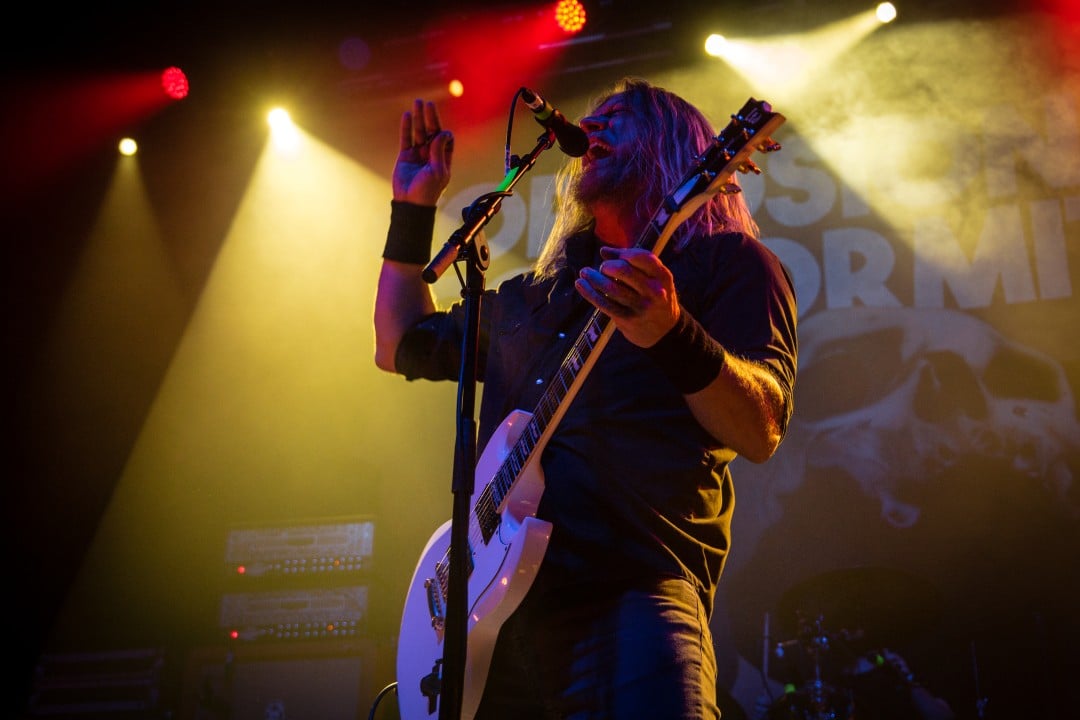
Musician Pepper Keenan, known for his work with Corrosion of Conformity, recalled on August 12, 2026, the impact and surprise he felt when he received an invitation to test as Metallica’s provisional guitarist in 1992.
This scenario unfolded after James Hetfield suffered serious burns in an on-stage pyrotechnics incident, leaving him unable to play his instrument.
Metallica’s management team, Q Prime, began an urgent search for a replacement guitarist to ensure the continuity of the band’s tour, which featured Guns N’ Roses. It was at this point that Keenan, who was also on tour, emerged as an option.
Keenan told the Garza Podcast in a recent episode: “My phone rang at my hotel at three in the morning, and it was Q Prime. I mean, ‘How did you guys know I was here and at which hotel?'”
He added, stating that the team “was probing the ground”. Keenan expressed his doubts at the time: “I was like, ‘Man, for starters, it’s a stadium tour. Metallica has never been this tight in their entire lives. And you guys want some idiots to come and try to be Hetfield? Is that what you’re saying?’ And they were like, ‘Yeah.'”

Despite the uncertainties, Keenan accepted the audition proposal. First, however, he had to inform his tour partner, Henry Rollins. He said the Metallica material was faxed directly to his hotel room: “I had to go tell Henry Rollins. I was like, ‘I don’t know how to explain this, Mr. Rollins…’. And I flew to Denver, Colorado, the next day.”
On the same topic: Pepper Keenan recalls the unusual invitation to replace James Hetfield in Metallica in 1992
The musician still maintained his reservations, commenting: “That’s bullshit. I mean, they’re losing a million dollars a day not playing. That was serious stuff. And I’m a 20-year-old guy sitting in their shoes in Denver, Colorado – a top-secret bunker.”
The unexpected revelation about James Hetfield during the test
Keenan discovered that Hetfield was present as the best burn treatment center in the United States was nearby. “Hetfield was there because the best burn center in the United States was nearby. I thought, ‘This is great!'” Keenan described the environment as “intense” and his main concern was the pressure of “learning so many songs so quickly and so well.”
He stated: “I said, ‘Man, that’s not going to happen.’ … And I think at the end of the day, they asked his coach to do it.”
An unexpected positive for Keenan, who would eventually audition for Jason Newsted’s place in Metallica, was knowing that Hetfield had considered him as a possible solution to the 1992 situation. “And we became friends after that,” said Keenan.
Conceptual albums that marked rock for their eccentricity
Below, we present a selection of albums that stood out for their more unusual proposals, complex plots and non-standard sounds within the rock universe.
The Pretty Things’ “SF Sorrow” and its 1968 mystical narrative
Released after The Who’s mini-opera, A Quick One, While He’s Away, but preceding the same band’s first rock opera double album, Tommy, SF Sorrow is widely recognized as the first rock opera in history. The work of The Pretty Things narrates the trajectory of its main character, Sebastian, from his birth and adolescence to a spiritual and melancholic journey, with the story told through the internal liner notes. However, the album did not appear in the UK charts and only reached the United States in 1969, through Motown’s Rare Earth label, which focused on rock, and did not find a large audience at the time.
The Four Seasons’ bold “Gazeta da Vida” in 1968
The Four Seasons’ AM pop sound, with a strong doo-wop influence, began to seem old-fashioned in the musical scene that followed “Sgt. Pepper’s”. However, the group tried to change this perception with “The Genuine Imitation Life Gazette”, from 1969. This album was a fusion of conceptual album and pop art, with a cover that simulated a newspaper. Their songs were united by the naturalness of everyday experiences. With a bold musical approach and psychedelic touches, the lyrics were precise, covering themes such as birth, death, love and divorce. It represented an authentic effort to showcase a deeper aspect of the Jersey Boys still not fully appreciated five decades later. Producer Bob Gaudio incorporated the learnings from this work into his subsequent project: “Watertown”, Frank Sinatra’s 1970 concept album.
The Turtles’ “Battle of the Bands”: A Year of Pseudonyms in 1968
Twelve months after The Beatles introduced themselves as another band in “Sgt. Pepper’s Lonely Hearts Club Band”, The Turtles expanded on this idea. All tracks on “The Turtles Present the Battle of the Bands” were recorded under assumed identities, such as Atomic Enchilada, Cross Fires, and Chief Kamanawanalea and his Royal Macadamia Nuts. This album gave The Turtles their last two Top 10 hits: “Elenore”, credited to Howie, Mark, Johny, Jim & Al, and “You Showed Me”, attributed to Nature’s Children.
“Ogdens’ Nut Gone Flake” by Small Faces and the search for half the moon in 1968
The Small Faces devoted the second half of “Ogdens’ Nut Gone Flake” to a six-song suite titled “Happiness Stan,” an imaginative, psychedelic fairy tale about a man searching for the missing half of the moon. British actor Stanley Unwin was invited to perform narrations between tracks. The entire album was packaged in a round metal tin, inspired by the brand of tobacco that the title itself parodied.
The Shaggs’ “Philosophy of the World”: Obscurity and influence on rock in 1969
Composed of sisters Dorothy, Betty and Helen Wiggin, The Shaggs were an enigmatic and quirky trio who were on the brink of oblivion. Their father, certain of his daughters’ talent, took them to a studio in 1969 to record the LP “Philosophy of the World”. Released on the band’s own label, Third World, the album was not commercially successful. In 1980, admirers Terry Adams and Tom Ardolino, from NRBQ, convinced Rounder Records to re-release this forgotten work. “Better than the Beatles – even today,” declared Frank Zappa on the LP’s back cover. The song that gives the album its name explores the idea that “the rich want what the rich want, and the poor want what the rich want”, drawing parallels between different groups before concluding that “you can never please everyone in this world”. Later, they ask “Who are the parents?”, before presenting the narrative of “My Pal Foot Foot”. In the end, the sisters conform to this worldview, proclaiming “We have a Savior.” His lyrical observations were fascinating, and musically, they inspired Sonic Youth and several other indie rock bands with their quirky guitar tunings.
Full coverage: Latest News (EN)
“Blows Against the Empire”: Paul Kantner’s 1970 Space Journey
With the departure of Spencer Dryden from Jefferson Airplane, Paul Kantner released a solo work that featured the participation of all the other members of the band, except vocalist Marty Balin. Credited to Kantner and Jefferson Starship — which would only consolidate itself as a group in 1974, after the separation of guitarist Jorma Jaukonen and bassist Jack Casady —, “Blows Against the Empire”, from 1970, merged the ideals of counterculture with space exploration. The plot chronicles a hippie commune, tired of the government, who steals a spaceship to create a utopian society in space. In addition to his Airplane colleagues, Kantner collaborated with David Crosby, Graham Nash and three members of the Grateful Dead.
Jethro Tull’s iconic “Thick as a Brick”: A satire that became a classic in 1972
After “Aqualung” was classified by music critics as a concept album, at odds with Ian Anderson’s perspective, Jethro Tull decided to mock the genre in their next project. In “Thick as a Brick”, Anderson criticized the specialized media, the band’s admirers and even the group itself throughout the entire work. Whether it was a parody or not, the public loved it. With a single 44-minute track filling both sides of an LP, there was no way to release singles. Even today, it is considered one of the highlights of Jethro Tull’s career. According to Anderson, in an interview with Bravewords, the album’s main asset is its humor, which remains discreet enough “so that you don’t get irritated by the album because it’s too artistic, too clever, too bombastic.” By satirizing concept albums, Anderson and his band ended up creating one of the greatest examples of the genre.
The complexity of Yes’ 1973 “Tales From Topographic Oceans”
After the ambitious “Close to the Edge,” Yes delved deeper into a complex conceptual double album called “Tales From Topographic Oceans.” The work, composed of four long tracks, ended up confusing listeners. “The Revealing Science of God” was a very distant proposal from “Good Golly Miss Molly”, and the absence of striking melodies, combined with an unclear concept, ended up dividing part of the Yes fan base. But what, in fact, was the concept? It was related to vocalist Jon Anderson’s interest in Yogi Paramahansa Yogananda and Hindu texts. Keyboardist Rick Wakeman had difficulty understanding the proposal, even commenting during a solo show: “Have I ever gotten drunk on stage? It was the only way I could play ‘Tales From Topographic Oceans’.” He left the band shortly after the tour to support the album.
Faith in “The Plan”: The Osmonds’ foray into spiritual music in 1973
The Osmonds’ origins and upbringing in the Mormon faith were public knowledge, and on 1973’s “The Plan” they sought to fully incorporate their beliefs into their musical artistry. The “plan” addressed here is that of salvation through Jesus Christ, as detailed in the Book of Mormon. Starting with “War in Heaven” and progressing to the final track “Goin’ Home”, the album is full of songs inspired by faith, all composed, performed and sung by the brothers. The work delves into its sweet harmonies, with some truly engaging sections. Tracks like “Traffic in My Mind” and “The Last Days” exemplify this. Although “The Plan” does not reach the same level as “Crazy Horses”, from 1972, the album demonstrated that the Osmonds were a group with much more depth than publications at the time usually indicated.
“Soap Opera” by the Kinks: A musician searching for the meaning of life in 1975
Created near the end of The Kinks’ extensive era of concept albums, “Soap Opera” tells the story of Starmaker, a musician who decides to trade places with an ordinary person, Norman, to gain a new understanding of the real meaning of existence. He is faced with the tension between fortune and notoriety, as well as a mundane routine that awaits him. With the inclusion of a brass section, among other elements, “Soap Opera” houses one of Ray Davies’ most ambitious visions. Released in mid-1975, the album failed to captivate either the public or radio stations. Although it is a somewhat forgotten work in the band’s vast discography, “Soap Opera” has its moments, even if they sometimes seem a little excessive.
The experimental noise of Lou Reed’s 1975 “Metal Machine Music”
Why does Lou Reed’s “Metal Machine Music,” an instrumental double album with no lyrics, appear on this list of concept albums? Because your very existence is a concept. Composed of four sides of non-stop feedback, guitar noise and sound effects, the album has the power to make people flee in panic or to cause them to contemplate the profound artistic statement that Reed was proposing. Rolling Stone magazine called it “an act of provocation, an affront,” arguing that it was “hopelessly old-fashioned” and that, “after a decade of aesthetic outrages, four sides of what sounds like the tubular groan of a galactic refrigerator simply isn’t going to inflame the bourgeoisie.” To this day, the work continues to provoke intense reactions, but the question remains: who had the last laugh? Those who ridiculed Reed and his conceptual “art,” or Reed himself?
Kiss’ “Music From The Elder”: The foray into good and evil in 1981
After reading a short story written by bassist and vocalist Gene Simmons, producer Bob Ezrin was inspired to develop a concept album for Kiss. After all, what was the plot of “Music From the Elder”? It was about the fight between good and evil, with the emergence of heroes. Simmons explained to Classic Rock in 2016 that “The Elders are a disembodied life form. They are benevolent but committed to the balance of opposites. And when the darkness becomes too strong, a hero is born to restore the balance.” The single “World Without Heroes” was co-written with Lou Reed. The public was not used to seeing their idols masked in such an introspective record. Sound engineer Rob Freeman shared his take on the work: “I thought it was a bold attempt at something intriguing. It’s true that it didn’t exude the typical Kiss sound, but rather it was subtly infused with it.”
“Space Jazz”: L. Ron Hubbard’s 1982 Sci-Fi Soundtrack
L. Ron Hubbard, science fiction writer and founder of the Church of Scientology, designed a soundtrack for his book “Battlefield Earth.” He composed the music and invited renowned instrumentalists such as studio pianist Nicky Hopkins and jazz icons Chick Corea and Stanley Clarke, all of whom were members of the church. The keyboard arrangements give the album a characteristic sound from the early 80s. Despite the great talent involved, the final product is a fusion reminiscent of a musical, a PBS children’s program and the soundtrack of a disaster film.
The “Journey into the Secret Life of Plants”: Stevie Wonder explores the instrumental in 1979
After redefining R&B with five albums released between “Music of My Mind” (1972) and “Songs in the Key of Life” (1976), Stevie Wonder’s next project was the soundtrack for the documentary “The Secret Life of Plants”. The album was mostly instrumental, and the few tracks with lyrics, with the exception of the hit “Send One Your Love”, were based on the original material and departed considerably from the love songs and social observations present in their most acclaimed productions. Although Wonder did not face major commercial losses, he did not again reach the same artistic heights as his early and mid-1970s work.
Styx’s “Kilroy Was Here”: Paranoia and Creative Differences in 1983
At the end of the 70s, Styx already enjoyed great recognition with hits such as “Lady” and “Come Sail Away”. The band had explored concept album territory with 1981’s “Paradise Theater,” and frontman Dennis DeYoung harbored an ambitious vision for the next project. “Kilroy Was Here” focused on a narrative about the growing concern about the supposed harms of rock music and the potentially dangerous messages conveyed to global youth. DeYoung devised a complete show, which included a film, to tell the story. However, a tour exposed creative differences between DeYoung and the other members of Styx, leading guitarist Tommy Shaw to leave the group midway through the tour.
Frank Zappa’s 1984 Bizarre Satire of “Thing-Fish”
Frank Zappa was known for his satirical concept albums, but “Thing-Fish” stood out for its eccentricity even by his own standards. Conceived as a Broadway musical that addressed a disease similar to AIDS, created to target blacks and gays, the triple album used stereotypes of African Americans, gay men, feminists and white Anglo-Saxon Protestants. MCA, the distributor for Zappa’s Barking Pumpkin record label, refused to distribute the album, leading the artist to enter into a single LP deal with Capitol. The musical, however, was never produced during Zappa’s lifetime.
Alternative history and the occult in “Imaginos” by Blue Öyster Cult in 1988
More than twenty years after Sandy Pearlman developed a series of poems and scripts called “The Soft Doctrines of Imaginos”, the band he managed and wrote the lyrics for, Blue Öyster Cult, turned these texts into music. “Imaginos” begins in 1804 in New Hampshire and seeks to build an alternative narrative for the following two hundred years, integrating themes such as occultism, astrology, the First World War and other elements, all from the perspective of the main character, who has superpowers. The initial intention was for the work to be a trilogy of double albums, but only one LP was actually released.
Billy Idol’s “Cyberpunk”: The Fusion of Technology and Music in 1993
Billy Idol’s highly successful run came to a turning point when he set aside his traditional fusion of dance music and hard rock to embrace electronic beats and samples in 1993’s “Cyberpunk.” The album’s narrative, presented through spoken-word excerpts between songs, was born out of Idol’s growing fascination with the works of William Gibson and other authors whose works addressed the increasingly present influence of technology at the dawn of the internet era. Idol would only release a studio album again twelve years later.
The fictional life of Chris Gaines: Garth Brooks and his rocker alter ego in 1999
With the desire to expand his horizons after establishing himself as the most successful country artist in sales, Garth Brooks gave life to an alter ego called Chris Gaines. This Australian rocker, with shaggy bangs and a goatee, got an album, “The Life of Chris Gaines,” which was imagined as a greatest hits collection of a fictional star. Brooks had lofty ambitions for Gaines, including a film titled “The Lamb.” He introduced his creation through a special on VH1 and an appearance on “Saturday Night Live.” Despite the success of “Lost in You”, which reached the Top 5, the change alienated their country music fans, and the rock scene, in general, did not show much enthusiasm.
Judas Priest’s “Nostradamus”: The Life of a Prophet in 2008
Michel de Nostredame, now known as Nostradamus, was a 16th-century Frenchman whose book “Les Propheties” is often interpreted as an accurate preview of events in modern history. In 2008, Judas Priest considered that the life of Nostradamus would be an ideal theme for their first concept album. However, the band’s admirers were dissatisfied with the work, not so much because of the concept itself, but because of its execution, which presented lackluster ballads and arrangements that favored keyboards and strings.