3,600-year-old tomb discovered in Egypt reveals king of lost dynasty
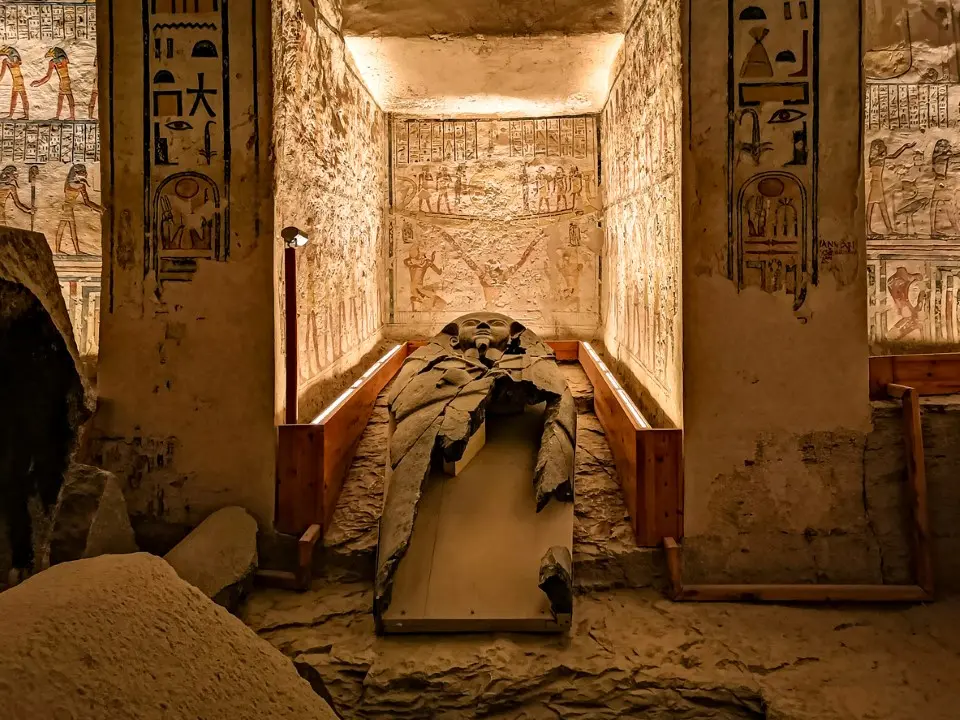
A collaboration between the Penn Museum and Egyptian archaeologists, along with the Egyptian Ministry of Tourism and Antiquities, resulted in the discovery of a vast tomb of an unidentified pharaoh. The location of the find is the ancient necropolis of Anubis Mountain, in Abydos. This discovery is expected to bring new information about a long-forgotten dynasty and a less explored period of Egyptian history.
The burial chamber, which dates back 3,600 years and is made of limestone, was found almost seven meters underground in January 2025. The impressive structure has a decorated entrance and several other rooms, which are covered by five-meter-high clay brick vaults. This marks the second major tomb of an Egyptian king announced in 2025.
On the same topic: Discovery in El Salvador reveals human remains from 850 BC under volcanic ash
Abydos, one of the oldest cities in Upper Egypt, is located approximately ten kilometers from the Nile River. It is believed to be the burial place of Osiris, the god of the underworld, and a portal to the afterlife. This sacred city also functioned as a royal necropolis, being the favorite final resting place of the first pharaohs and exerting great influence on the ancient power structures and political development of Egypt.
Although the identity of the king buried in this tomb remains unknown, it is known that he ruled during the Second Intermediate Period, between 1640 and 1540 BCE. This era was characterized by great economic and political instability, promoting important social and technological transformations in an Egypt fragmented by rival and warring kingdoms. One of these kingdoms was the Dynasty of Abydos, a series of monarchs who controlled part of Upper Egypt and whose existence was confirmed in 2014, through excavations led by Dr. Josef Wegner, curator of the Egyptian Section of the Penn Museum and professor of Egyptian Archeology at the University of Pennsylvania. That year, his team revealed the tomb of King Seneb-Kay, another ruler of that same dynasty.
Similarities in decoration and architecture between the tombs excavated in 2014 and the 2025 discovery led Penn Museum archaeologists to believe that the unknown ruler may have been a predecessor of King Seneb-Kay. Despite the comparable design, the newly unearthed tomb is considerably larger than that of Seneb-Kay or any other known monarch of the same dynasty buried there.
More on this story: Unprecedented discovery: archaeologists find fragment of Homer’s Iliad in 1,600-year-old Egyptian mummy
See Also

Virginia Fonseca leaves Grande Rio to focus on new businesses: ‘Ready for one more’

Humanoid robots will compete in new disciplines at the Beijing World Games

Barcelona raises proposal for Rodri and approaches the minimum value required by Manchester City
In bands of yellow hieroglyphics, which adorned the place, the king’s identity was once recorded.
“The king’s name was originally recorded in scenes painted on the plastered brickwork that decorated the entrance to the limestone burial chamber,” said Dr Wegner. These paintings depict Isis, the ancient Egyptian goddess of motherhood and healing, and her sister Nephthys, often seen alongside Isis in funeral rituals. “However, ancient tomb robbers damaged the hieroglyphic texts, and not enough were left to read the king’s name. There are several possible owners for the new tomb, including two kings named Senaiib and Paentjeni, who dedicated monuments at Abydos, but whose tombs remain unknown.”

Dr Wegner added that the tomb confirms the existence of other ancient kings buried in and around the enclosure of Pharaoh Neferhotep I, a 13th Dynasty monarch who reigned a century before the Abydos Dynasty.
Learn more: Rare discovery: 2,000-year-old Indian inscription found on gold ring in Thailand
Excavations will continue through 2025 in this new focus area on Anubis Mountain, which covers approximately 10,000 square meters of desert terrain. Advanced technologies will be used, such as remote sensing, magnetometry (magnetic mapping) and photogrammetry (three-dimensional modeling of tombs).
“The ongoing excavations also include the protection, site management and conservation of these structures. This is part of our commitment to the site in cooperation with the Egyptian Ministry of Tourism and Antiquities,” said Dr Wegner. “Together, we have already opened the tombs of King Seneb-Kay and King Senwosret III as visitable monuments, and are in the process of opening others in the same area where this new tomb was found. This discovery is a new window into understanding the origins of the enigmatic Abydos Dynasty.”