Interstellar comet 3I/ATLAS appears in old Rubin Observatory records before it was discovered
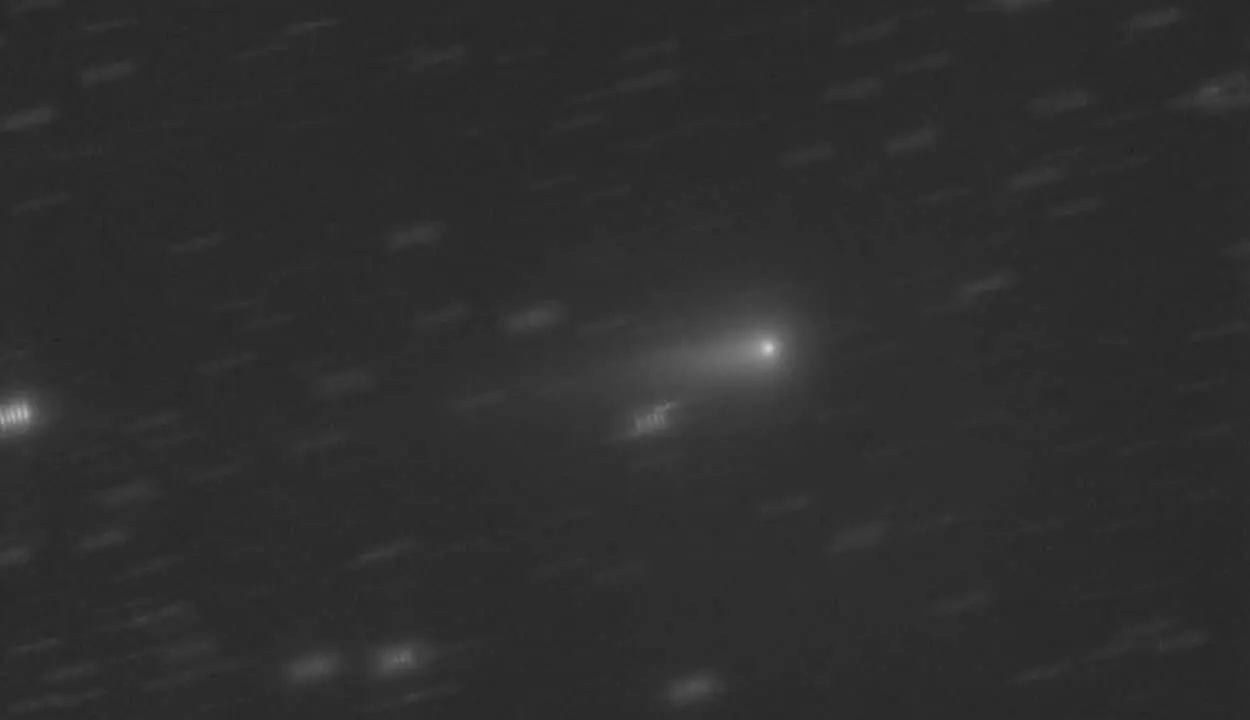
Scientists have revealed that the interstellar comet 3I/ATLAS was recorded by the Vera C. Rubin Observatory days before its official identification. The images, captured during the telescope’s scientific validation phase, reveal the presence of the cosmic visitor on June 20, 2025, prior to the announcement made by the ATLAS system on July 1, 2025. This early detection highlights the new observatory’s ability to locate rare celestial objects.
Interstellar comets are cosmic travelers that originate from outside our solar system, offering unique clues about the formation and evolution of other planetary systems. The rarity of these objects makes each discovery valuable for understanding astrophysical processes occurring in different parts of the galaxy. 3I/ATLAS represents an unprecedented opportunity to study a piece of another star system in detail.
Researchers use customized methodology to identify objects in old data
Comet 3I/ATLAS was officially identified on July 1, 2025 by the ATLAS system (Asteroid Terrestrial-impact Last Alert System), a global network of robotic telescopes based in Hawaii, Chile and South Africa. However, the Vera C. Rubin Observatory, also located in Chile, had begun its scientific validation phase ten days earlier, on June 20, 2025, as part of the preparation for its full operation, scheduled for the end of the year.
More on this story: Historic approach to Mars in 2035 opens unprecedented window for manned missions from NASA and China
Intrigued by the possibility that Rubin had spotted the comet earlier, a team led by Colin Orion Chandler of the University of Washington analyzed data from the telescope’s commissioning phase. They confirmed that 3I/ATLAS was imaged on Rubin’s first night of testing, on June 20, 2025. This search was not straightforward, as the observatory’s data processing system was not yet fully active, requiring Chandler and his team to develop a custom methodology to access and analyze the information.
Initial observations from 3I/ATLAS reveal signs of activity in its coma
After the first detection, the Rubin Observatory continued to record the interstellar comet nine times between June 21 and July 2, 2025, and several more times until July 20 of the same year. The images revealed that 3I/ATLAS was already active even before it was officially identified by ATLAS. It was possible to observe an evident coma, a cloud of dust and gas that forms around the nucleus of a comet as it approaches the Sun and its material sublimates.
The Vera C. Rubin Observatory, with its 10-year Legacy Survey of Space and Time (LSST), has the capacity to find up to 10,000 new comets. The early detection of 3I/ATLAS by this observatory is a promising indication that it will be able to identify, on average, one interstellar comet per year, contributing significantly to the study of celestial objects from other galaxies.
See Also

August sky: 9 unmissable astronomical events, with solar eclipse and meteor shower

Louvre chooses architects for new Mona Lisa suite and plans expansion of visitors

Check out the 10 most watched series on Netflix in 2026, according to new data
Learn more: Space agencies review 40 years of Halley’s Comet data to plan future orbital mission
JUICE and Europa Clipper probes perform unprecedented joint observations
While comet 3I/ATLAS is still transiting through our solar system, new information continues to be revealed by space missions that monitor it. The joint observations were crucial when the comet was hidden by the Sun in October 2025, coinciding with perihelion, its closest point to the star, where activity was expected to be maximum.
Scientists at the Southwest Research Institute (SwRI), who lead the Ultraviolet Spectrograph (UVS) instruments on the European Space Agency’s JUICE and NASA’s Europa Clipper missions, confirmed coordinated 3I/ATLAS observations in late 2025. Both probes are en route to Jupiter, with JUICE focused on the icy moons and Europa Clipper on Europa. SwRI’s Kurt Retherford reported: “As the comet passed between JUICE and Europa Clipper, we were able to informally coordinate observations between the two spacecraft.” This collaboration allowed JUICE to view the sunlit side and Europa Clipper the night side, providing a more complete view of gas emissions.
Composition analysis reveals details about the comet’s interstellar origin
Joint observations by the space probes’ UVS instruments detected hydrogen, oxygen and carbon, elements produced by the interaction of the comet’s gases with the Sun’s ultraviolet light. Notably, the composition of 3I/ATLAS presents characteristics that differentiate it from local comets:
- Excess carbon:The carbon abundance was higher than expected for comets originating in our solar system, a finding that validates previous James Webb Space Telescope observations of carbon dioxide.
- Water ice and dry ice:Analysis of the ratio of water ice to dry ice (carbon dioxide) allows researchers to compare the formation environment of 3I/ATLAS with that of our own solar system, indicating possible differences in the original composition.
- Age and speed:The core, about a kilometer in diameter, moves at approximately 225,300 kilometers per hour (61 km/s), suggesting an estimated age of between seven and twelve billion years and a history of multiple stellar interactions.
Philippa Molyneux of SwRI said: “This helps us understand whether the solar system where 3I/ATLAS formed is similar to ours or different.” These discoveries deepen knowledge about the formation of planetary systems outside our own and highlight the importance of combining observations from different telescopes and missions to unravel the mysteries of the universe.