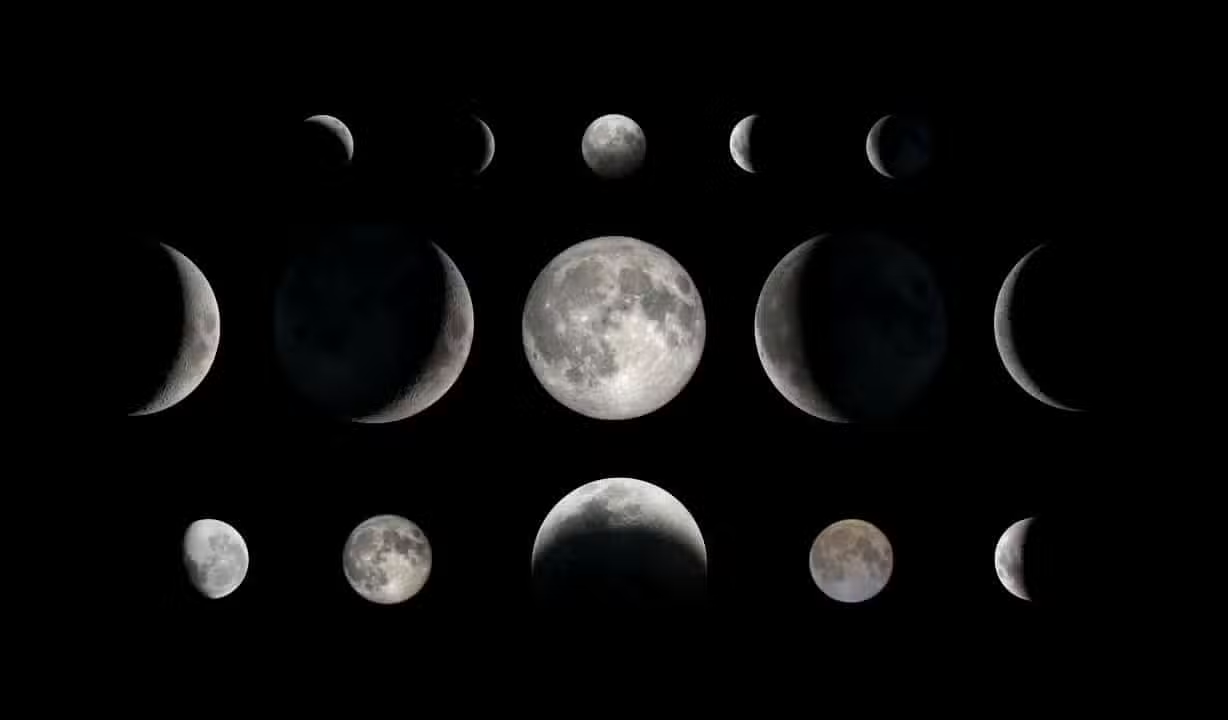
The second supermoon of 2025 occurs this Wednesday, November 5th, with visibility on all continents. The phenomenon coincides with lunar perigee, when the satellite reaches the closest point to Earth, approximately 356,980 km away. Astronomers confirm that this is the biggest and brightest of the year, surpassing previous events since 2019.
The peak of the full moon varies by time zone, starting at dusk in regions such as North America, Europe and Asia. Observers see the disk 14% larger and 30% brighter than usual, without the need for equipment. Clear weather conditions favor vision in urban and rural areas.

- Peak New York time: 8:19 am ET.
- In London: 13:19 GMT.
- In Rio de Janeiro: 10:19 am BRT.
Origin of term
The concept of a supermoon emerged in 1979, created by astrologer Richard Nolle. Astronomers adopted the term for full moons near perigee, below 360,000 km from Earth.
The definition varies among experts, but the consensus involves the lunar elliptical orbit. Not all full moons meet the proximity criteria.
Continental times
The technical full moon lasts for an instant, but appears full for three days. Astronomical platforms list times adjusted by location.
In South America, the emergence occurs around 5 pm in capitals such as Buenos Aires. Europe records the event early Wednesday night.
Asia sees the peak in the early hours of Thursday. Africa and Oceania follow intermediate time zones for optimized visibility.
Yearly Calendar
Three supermoons mark 2025, according to international observatories. The first took place on October 7th, known as Hunter’s Moon.
November marks the second event. The third appears on December 4th, as Cold Moon.
The year records an annual average of occurrences, influenced by the orbital elliptical. Global observations confirm consistent patterns.
Size differences
Supermoons exceed ordinary full moons in apparent diameter by up to 14%. Amplified brightness results from reduced proximity.
At its apogee, the satellite appears smaller, forming micromoons. The variation affects tides with slight increases of up to 5 cm.
Visual comparisons highlight the effect during moonrise. Regional photographs capture the contrast in different hemispheres.
Tips for Observers
Select points with a wide horizon and low light pollution. Sunrise at dusk enhances the apparent size through optical illusion.
Binoculars reveal lunar craters and seas. Cell phones in night mode record images without a mandatory tripod.
Cultural names
North American indigenous traditions call the event Beaver Moon, after beaver activity in November. Other nicknames include Frosty Moon and Hunter’s Moon.
In Europe, Snow Moon prevails in some regions. Southern Hemisphere adopts local terms such as Beaver Moon.
These names reflect seasonal and agricultural cycles. Indigenous Asian people use designations linked to autumn harvests.
Visibility by hemisphere
The phenomenon covers the entire planet simultaneously. In the North, it coincides with boreal autumn and Taurid meteor showers.
The south records an austral winter with darker skies. Seasonal differences alter the visible stellar background.
Global observatories predict high success rate on clear nights. Records from 2024 confirm universal accessibility.
The elliptical lunar orbit determines the annual intensity, with minimum distances varying per cycle. In 2025, November offers the closest perigee, 221,818 miles from Earth, according to NASA calculations. This setting not only enlarges the visible disk but also intensifies brightness, allowing for subtle shadows on bright surfaces at night. To theTronomers such as those at the National Observatory and the University of Surrey emphasize that the event encourages amateur observations on a global scale, promoting celestial education without technological barriers.
Associated events
Taurid meteor showers peak on November 4th and 5th. Up to 5 meteors per hour cross the sky near the moon.
The Pleiades cluster forms a triangle with the moon and the star Aldebaran. Observers in the constellation Aries capture the full scene.