A new technology developed by Brazilian scientists promises to transform how consumers check the freshness of fish and seafood. Using natural pigments extracted from purple cabbage, a smart packaging changes color to indicate if the food is spoiled, eliminating the need for sensory tests like smelling or touching. The innovation, led by the Brazilian Agricultural Research Corporation (Embrapa) in partnership with the University of Illinois in the United States, combines sustainability and practicality, using recyclable materials and accessible production techniques.
This solution emerges at a time when food safety is gaining global attention, with consumers seeking reliable ways to ensure product quality. The packaging, made of nanofibers, detects chemical changes in the food and translates these changes into clear visual signals. The research, which has shown promising results in tests with hake fillets, represents a significant advance for the food industry.

Key features of the technology:
- Use of anthocyanins, natural pigments from purple cabbage, for monitoring.
- Nanofibers produced from food waste, promoting sustainability.
- Real-time color change, indicating spoilage without opening the packaging.
- Accessible production technique, with potential for industrial scale.
The innovation not only simplifies life for consumers but also has the potential to reduce food waste, a problem that affects millions of tons of products annually.
Natural pigments as the foundation of innovation
The technology developed by Embrapa uses anthocyanins, natural compounds found in vegetables like purple cabbage, which have the unique ability to change color in response to changes in the environment’s acidity level. When applied to nanofiber mats, these substances monitor compounds released during fish spoilage, such as biogenic amines, which signal the presence of bacteria.
In the tests conducted, the packaging displayed a clear color progression. Initially purple when the fish was fresh, the shade changed over 72 hours, transitioning through less intense tones to a grayish-blue, indicating the food was no longer safe for consumption. This system allows consumers, retailers, and distributors to identify product quality visually and instantly.
The choice of purple cabbage as the source of anthocyanins was deliberate. Besides being an accessible and abundant material, it offers a natural and safe solution, eliminating the need for synthetic dyes or potentially harmful chemicals. The research also explores the use of other anthocyanin-rich plants, such as grapes and jabuticabas, to diversify the technology’s applications.
Innovative production process
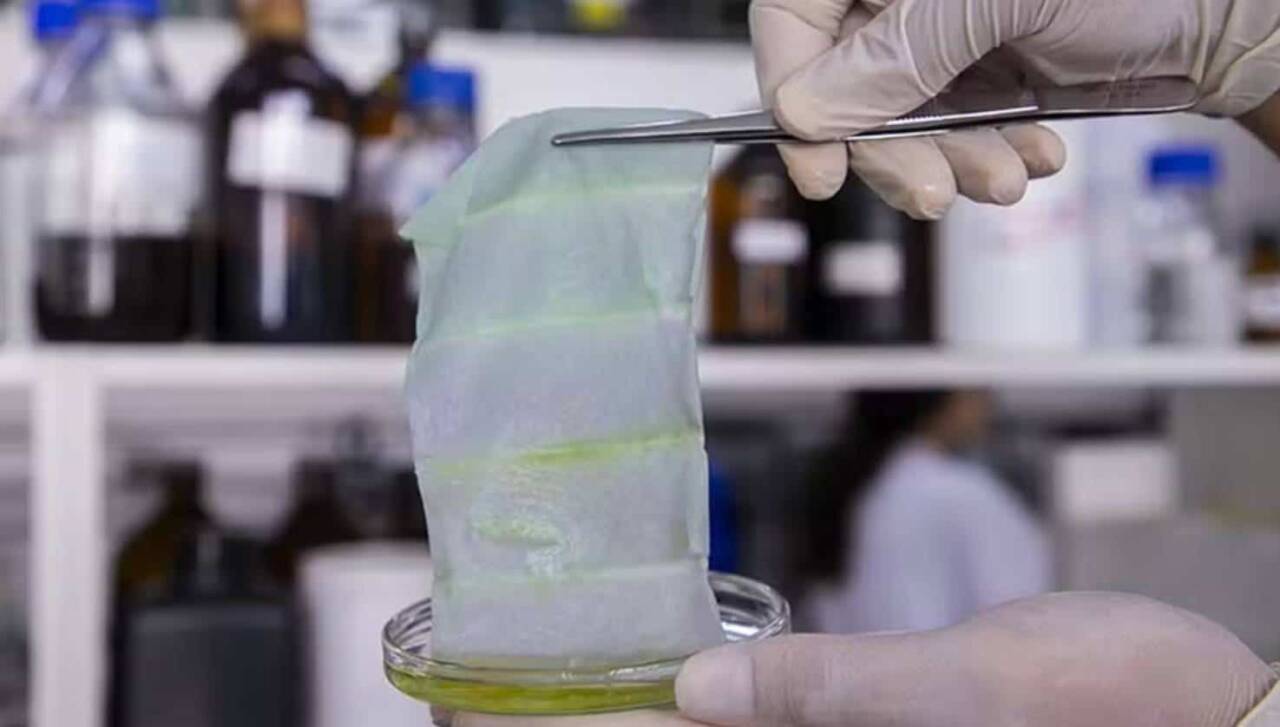
The creation of nanofiber mats uses a technique called solution blow spinning, which enables the production of extremely fine fibers quickly and cost-effectively. In this process, compressed gas is used to shape the fibers, which are deposited onto a collector, forming a lightweight fabric-like structure.
Unlike traditional methods, which can be expensive and energy-intensive, this technique stands out for its efficiency.
- Large-scale production with reduced costs.
- Use of food waste as raw material, minimizing environmental impact.
- Energy-efficient process, with lower carbon emissions.
- Flexibility to adapt the technology to different types of food.
The simplicity of the method makes the technology viable for implementation in small and medium-sized industries, as well as large manufacturers. Researchers also highlight that the technique can be adjusted to produce packaging with varying thicknesses and properties, depending on the type of food being monitored.
Detailed laboratory tests
The initial experiments by Embrapa focused on hake fillets, a widely consumed fish in Brazil and worldwide. During the tests, the packaging was stored under controlled conditions, simulating the environment of a household refrigerator.
After 24 hours, the initial purple color began to fade, indicating the first signs of spoilage. By 48 hours, bluish tones emerged, and after 72 hours, the packaging displayed an intense blue color, confirming the fish was no longer safe for consumption. These results were consistent across multiple tests, demonstrating the technology’s reliability.
The system’s accuracy is attributed to the sensitivity of anthocyanins to subtle chemical changes. In addition to detecting acidity, the nanofibers identify volatile compounds released by bacteria, such as Pseudomonas, often associated with fish spoilage. The tests also included microbiological analyses to confirm that the color changes corresponded to actual contamination levels.
Sustainability as a key differentiator
Environmental concern is at the core of the project. The nanofiber mats are produced from food waste, such as vegetable peels and scraps, which would otherwise be discarded. This approach reduces the ecological footprint of production and aligns the technology with demands for sustainable solutions in the food industry.
Moreover, the packaging is biodegradable, unlike traditional plastic packaging, which can take centuries to decompose. The ability to recycle agricultural materials into a functional product represents a significant step toward a circular economy.
Another positive aspect is the reduction of food waste. It is estimated that about 30% of food produced globally is wasted, often due to a lack of effective methods to assess quality. With the new packaging, consumers and retailers can make more informed decisions, avoiding premature disposal or consumption of spoiled products.
Applications beyond fish
Although initial tests focused on fish, researchers plan to expand the technology to other perishable foods, such as meats, poultry, and seafood. The versatility of anthocyanins allows the packaging to be adapted to monitor different types of spoilage, depending on the chemical characteristics of each food.
For example, in red meats, the packaging could detect lipid oxidation, while in seafood like shrimp, the focus would be on sulfur compounds. This flexibility opens doors to a wide range of applications in the food industry.
Potential future uses:
- Monitoring dairy products, such as cheeses and yogurts.
- Quality control for packaged fruits and vegetables.
- Application in processed foods, such as deli meats.
- Use in supply chains to track freshness during transportation.
Embrapa is also exploring the possibility of integrating additional sensors into the packaging, such as temperature indicators, to monitor improper storage conditions.
Challenges for commercialization
Despite promising results, the technology is not yet available on the market. Researchers emphasize that further tests are needed to ensure the packaging’s effectiveness with different fish species and other foods. Additionally, the stability of nanofibers under real-world storage conditions, such as temperature and humidity variations, must be evaluated.
Another point under consideration is consumer acceptance. While the packaging is visually intuitive, educating the public on how to interpret color changes is necessary. Awareness campaigns may be crucial to ensure the technology’s adoption.
Scalability is also a factor to consider. Although the solution blow spinning technique is cost-effective, mass production requires investments in infrastructure and partnerships with industry. Researchers are in discussions with food sector companies to enable commercialization.
Impact on the food industry
The introduction of smart packaging could transform the food supply chain. Supermarkets, for instance, could use the technology to manage inventories more efficiently, reducing losses and ensuring the safety of products offered.
Restaurants and delivery services would also benefit, as the packaging allows for quality checks without opening packages, maintaining hygiene. Additionally, the technology can be integrated into tracking systems, enabling distributors to monitor food freshness during transportation.
The innovation also has the potential to meet stricter food safety regulations. In many countries, authorities require reliable methods to ensure products are safe for consumption, and smart packaging can meet these standards.
Advances in collaborative research
The partnership between Embrapa and the University of Illinois was essential for the technology’s development. While Embrapa brought expertise in natural pigments and sustainability, the American university contributed knowledge in nanofibers and advanced production techniques.
This collaboration reflects a growing trend of international cooperation in food safety research. Similar projects are underway in other countries, such as the development of edible sensors in Japan and packaging with chemical indicators in Europe.
The exchange of knowledge between institutions also accelerates result validation. In the tests conducted, data collected in Brazil were compared with experiments in the United States, ensuring the technology’s consistency across different conditions.
Next steps in research
Researchers plan to expand tests to include a wider variety of foods and storage conditions. Additionally, they are exploring ways to make the packaging even more accessible, such as replacing expensive equipment with low-cost alternatives.
Another focus is developing a visual guide for consumers, with clear instructions on interpreting color changes. This material could be included on the packaging or made available through mobile apps, facilitating technology adoption.
Expected progress timeline:
- 2026: Completion of tests with other foods.
- 2027: Partnerships with industries for pilot production.
- 2028: Start of small-scale commercialization.
- 2030: Expansion to international markets.
Embrapa is also seeking funding to accelerate the project, including resources from government agencies and private investors.