Asteroid Apophis will make a historic pass by Earth in 2029 and can be seen with the naked eye
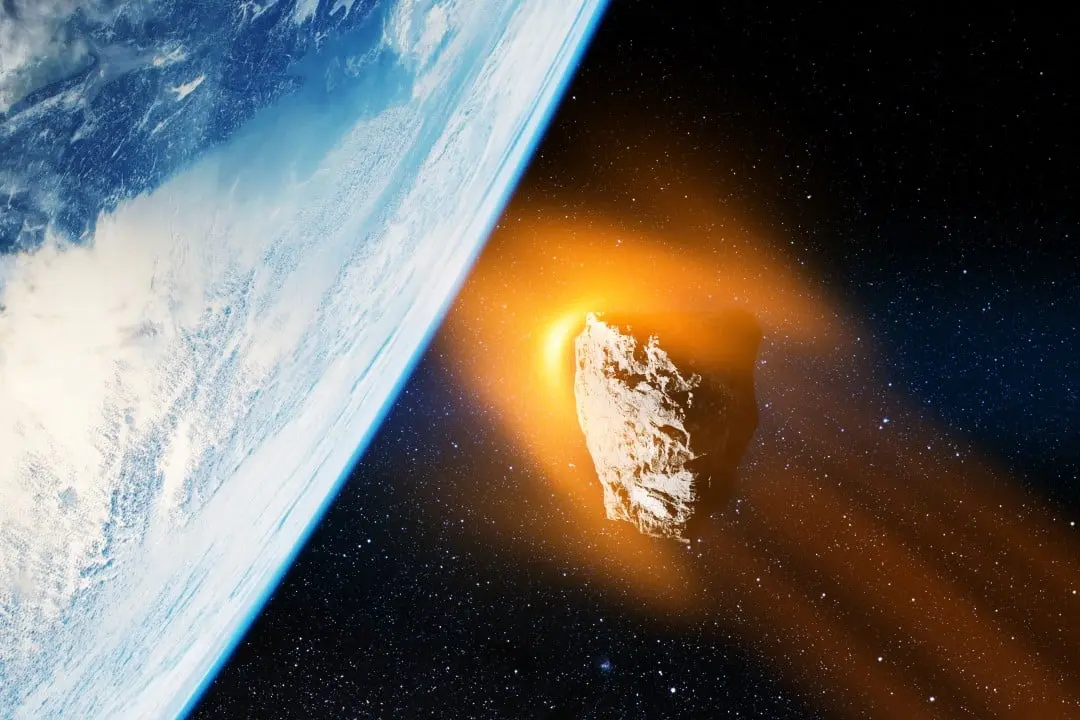
An unprecedented astronomical event is approaching: no object as large as the asteroid Apophis has ever come so close to our planet. In recognition of this milestone, the year 2029 has been designated as the International Year of Asteroid Awareness and Planetary Defense. The scientific community observes the phenomenon with great interest.
Mark your calendars: a unique experience is scheduled for April 13, 2029. On this date, a rare event, described as “once in a thousand years”, could be witnessed by up to 90% of the world’s population. Asteroid 99942, better known as Apophis, which means “God of Chaos” in Greek mythology, will pass at a distance of approximately 31,650 kilometers from Earth. This proximity is smaller than that of hundreds of space objects that orbit our planet, including the Moon itself.
The celestial rock is expected to shine with an intensity comparable to that of the stars in the Ursa Major constellation, appearing as a point of light that slowly moves across the sky.
It will be the first time that humans will be able to witness the passage of an asteroid with the naked eye, making it a memorable moment for many people. Most fascinating is that although Apophis orbits Earth every 10.5 months, residing between the orbits of Venus and our planet (with its origin probably in the main asteroid belt between Mars and Jupiter), its approach in 2029 is considerably more exceptional than its routine passes.
Asteroid Apophis: from fear of collision to focus on future studies
Despite its peculiar shape, which resembles a peanut, Apophis generated concern in the scientific community for a long period. With a diameter of about 450 meters, it was long classified as the asteroid most likely to collide with Earth. However, recent analyzes have completely ruled out any chance of impact, both for the passage of 2029 and for the next century.
The initial fear was that the approach of the “God of Chaos” would be so significant that the Earth’s gravitational force could alter its orbit. This cosmic deviation would not pose an immediate danger, but there was a small possibility that, on its return in 2036, Apophis could collide with the planet.
Learn more: Peak approach of giant asteroid to Earth occurs this Saturday, without danger of impact
However, new calculations have confirmed that the 2029 passage will be the only time the asteroid will come so close. After this date, the minimum distance between the celestial body and Earth will be at least 2.5 million kilometers.
Still, scientists will continue to monitor Apophis’ trajectory around the Earth. Among the planned actions is the sending of spacecraft, such as NASA’s OSIRIS-APEX, to fly over the asteroid and investigate its route around the Sun. Radio telescopes will also be used to emit radar waves on the rock’s surface to obtain more detailed information about its size and characteristics.
More on this story: Earth moves further away from the Sun this Monday, but without influence on the weather seasons
See Also
Preparation for asteroid impact: NASA expert highlights the urgency of planetary defense

Miss World Indonesia Putri Andriani Juficha dies on her 26th birthday

Pokémon Go users report massive failures with login and connection to the game server
Visibility of Apophis: billions of people will be able to observe, but there are exceptions
For approximately seven hours, 90% of the global population will have the opportunity to see the asteroid with the naked eye. However, it is important to highlight that the observation will depend on the geographic location of each person, which must be in a region covered by Apophis’ trajectory, and also on favorable weather conditions, with clear skies and low light pollution.
It doesn’t mean that all 7.6 billion people will see it simultaneously. Observation will begin in Australia and much of Asia, where around 4.5 billion “space observers” will be able to contemplate the phenomenon. As the asteroid continues on its path, visibility will extend to another 1.9 billion people in eastern South America, northern Africa and some parts of Europe.
On the same topic: Large asteroid measuring up to 1,650 meters will make a safe passage close to Earth on Saturday and will be monitored
Maximum visibility will occur around the halfway point of Apophis, when up to 5.7 billion people in eastern Africa, southern Europe, Australia and across Asia and the Middle East will have the best view.
However, billions of people will not be able to observe the passage, especially those residing in North America. For this reason, and also for scientific purposes, observatories and telescopes will capture detailed images of Apophis, using both the light reflected by the celestial body and the heat it emits to refine the understanding of its composition.
The closest approach to the rock will take place at 6:45 pm, Brasília time. However, its maximum brightness, also visible to the naked eye, will be reached a little earlier, at 5:35 pm.
During its passage, Apophis will present phases similar to those of the Moon. Initially, it will appear in a “waning” phase, with its largest portion facing the Earth and illuminated by the Sun. As it approaches, the side facing our planet will be partially illuminated and partially in darkness, to, in the end, be completely obscured by dim light.
More on this story: Updated research indicates Earth may escape the fiery end caused by the death of the Sun
In addition to being an extraordinary event in itself, researchers hope that the passage of Apophis will serve as an inspiration for the next generation of space scientists, boosting interest and research in the field of astronomy.